Friday, 14 September 2012

Planescape Next: Sort of, kind of

Since our last Spelljammery session set it up, I felt obliged to do a Planescapey session too. But I didn't want to be bound to Sigil and the Outer Planes, which take a lot of plot and character setup to really appreciate, nor did I want to risk the insanely adverse conditions of the Inner Planes. I wanted to just make up some interesting and unusual shit more or less on the fly, which is exactly what the Planescape setting is for.

As I see it, nobody at TSR ever expected us to use their philosophy-riddled setting to really achieve serious answers to deep philosophical questions on a routine basis, and it's better viewed as just a tool for provoking thought-provoking thoughts. So while the extensive set of books written to support this setting is full of excellent, interesting stuff, sticking narrowly to it all like dogma kind of misses the point, I think. If the fantasy genre is about exploring fantastic imaginary things, rather than automatically being about elves and wizards and dudes with swords running around forests and mountains, à la Tolkien, then Planescape is the most fantasiest of all the D&D settings. And so it's totally ok that I made up half of tonight's adventure in 2 minutes before work and the other half while we were busy playing it.

My original thought for last session's portal destination, at the time, was some sort of reverse Stargate scenario, where the players get pressed into helping the animal-headed followers of some god, as a militant branch of the Athar tries to kill it with a series of raids through the local portal. For some reason, I didn't go through with that, possibly because it felt too cheesey. Instead, I slapped something together at the last minute, which is not recommended as a routine method, but can occasionally produce wonders.

I began with a vague notion that it should be a thief-friendly adventure. If you know my regular players, nothing could make more sense. The philosophical 'hook-question' for the scenario that Planescape games depend on was "What is worth stealing?", so I knew I'd force the players to choose between several enticing options. And with the planes I'd already excluded, there weren't too many interesting places left to host this. The Astral and Ethereal on their own aren't much to work with, and the Prime Material Plane was where they'd just come from. Somehow, my brain finally got to Ravenloft's Demiplane of Dread as a useful model, with its apparently mundane, conventional appearance twisted by unusual, genre-focused local rules. But where Ravenloft is geared towards the horror genre, I wanted something made for common criminals, which a mid-game synonym search on my phone lead to be named the Demiplane of Delinquency.
The entire map of the Demiplane of Delinquency so far, plus combat notes from a previous session.

Before the game, all I really had was squeazed in at the top end of a page that already had some stuff on it left over from the previous week, on which I scribbled a very crude map of the four principle locations I wanted to cover: Don Quattro's Mansion, the Abandoned Werehouse District, the Kleptomancer's Tower, and the Maze. The first would be where they'd arrive and get their quest, the second two would be places to go to get McGuffins needed for the final bit, which would be the Maze, where treasure awaited. You'll note from the map above that these were hardly detailed locations, thoroughly prepared and intelligently populated.

And that's as far as I got before leaving for work, and didn't get time for another thought about it until I was at the roleplaying venue, unpacking my notes. While unpacking, I added a couple details: The whole plane would be permanently nocturnal and rainy/overcast, with architecture that wouldn't be out of place in Thief's city, the ability to travel between different parts of the city would have more to do with style and intent (being sneaky, in this case) than with effort or geography, and that there were sufficient appropriate pre-generated NPCs and monsters in the D&D Next playtest pack that I could keep the antagonists varied. I did end up borrowing the Dire Rat stats to simulate Were-rats, though, as the whole point of the Abandoned Werehouse District was the 'were' pun, and were-rats are surely the thiefiest of all lycanthropes. (Abandoned warehouse districts are a default part of all our roleplaying cities, have been for years and years, and I can't even remember where that joke came from.)

Then there were mob threats from the Don, ninja-versus-thief battles with the were-rats, an improvised cloak thing that I'd like to develop properly as a "thief demi-elemental", a cursed necklace of lycanthropy that one of the players stupidly put on in spite of the wizard PC's warnings AND which the key they needed from the Werehouse had stupidly become locked onto, beating the shit out of a lonely kobold guard, side-switching with the Kleptomancer (who I added very little detail to, but who could be an interesting NPC to expand) and then a near-lethal yet surprisingly anti-climatic fight against the Maze minotaur. Halfway through, I decided (and fed them this decision through the Kleptomancer) that the portal they'd arrived through was a one-way job, complicating their goals. I forget what all else I made up as we played, but I had a bunch of other thoughts for fleshing out this demiplane more thoroughly, which might come in handy in future. Stuff like the opposite sort of crime city, where everyone's a law-enforcer in a sort of Noir gumshoe setting (not a lawful-good utopia, just a place where everyone's focused on detection, the opposite of the first city's focus on evasion), and the 'neutral' brigandy woods acting as a filter between the two cities, imperfectly keeping criminals out of law city and cops out of crime city. That'd be the main source of conflict in this setting in longer stories, I think. I'll admit the Demiplane of Delinquency may not be the absolute most original idea ever, but I'm sure there are more interesting things that can be done with it than I did.

The final treasure came as a complete surprise to me, being one of those great ideas stolen from the players and fed back to them as the GM's own idea. I'd said there would be several treasures to choose from, but only one could be claimed, and I knew I wanted one to be enormous wealth, as the obvious thief-trap. I'd also stumbled into making the Kleptomancer say he wanted the super-duper magic treasure for himself. But, not wanting to reveal either of those too soon, I tentatively started off with a pair of other things I made up on the spot: A super-duper combat treasure and a romance treasure. As luck had it, I'd randomly claimed there were 6 treasure boxes in the final room, and the players leap on these clues as meaning that there was one treasure for each of the 6 basic attributes (combat for strength, romance for charisma, wealth for dexterity, magic for intelligence, and two others), so I ran with that and added invulnerability for constitution and a perfectly contented life for wisdom. They picked the magic and became more powerful than the system currently allows for, effectively retiring their characters and ending this test mini-campaign on a slightly odd note.

So maybe we didn't make a dramatically awesome new addition to the Planescape multiverse map, but we did get to test the D&D Next rules in a more urban setting, and they still seem to work well. We also tried something a bit new, which is what Planescape is all about, and which may be turned into something more serious and compelling with a bit more effort later on. And most important, I believe fun was had by all, which is not a bad way to start my birthday.

Thursday, 6 September 2012

Spelljammer Next: Initial playtest session

(EDIT: I scanned in my GM notes and added them to this blog, partly for later reference, partly to make the text a bit clearer.)

We tried playing with these rules mods last week, and it was pretty good. The idea was to test both the August 2012 D&D Next playtest pack and to see if my very rushed, crude Spelljammer adaptation would work with that, and the short answer to the latter is "yes."

Granted, we didn't get through too much actual spelljamming, as I decided to write up an introductory scenario that'd let the players and their characters transition naturally from being conventional Forgotten Realmsy dungeon crawlers of the sort they're more used to, into inexperienced spelljammers, and the transition took longer than expected because I put too many monsters on the ground and not enough in space. It actually dragged over 2 sessions, and the players who were only present for the 1st session didn't even get off the surface of Toril. The plot was basically: Drow pirates have found a treasure asteroid; Drow pirates are chased by goblin pirates and both crash-land within sight of the player-characters' village; Players get to seize the goblin ship (which had a serious helm fuck-up, presumably because of goblin stupidity) and salvage the working helm from the drow ship (which was simply shot down by the goblins), along with maps and instructions on how to work the ship and reach the asteroid; Players get to battle other drow ships defending the asteroid and then claim its "treasure".
Dockhill, players' map

Dockhill, GM's map and adventure notes.


You'll note I picked a couple of monster races that are pretty uncommon in Spelljammer, simply because they're among the few already prepared for D&D Next. Since my players have never done a real Spelljammer campaign, I don't think they noticed this. I gave the goblins (and thus the PCs) a squid ship and the elves a squadron of man-o-wars, figuring I'd follow the standard low-level dungeon model of players versus a larger number of relatively weak foes, allowing for a longer but more survivable combat rather than a fairer one that's over too quick.

Initially I was worried that the more manoeuvrable man-o-wars might be too hard for the players to out-turn, but they learnt very early on that their squid could tolerate rammings far better, and whatever numerical advantage the drow began with was negated, first by my players sneakily creeping up on the asteroid while the orbiting drow were out of sight on the far side of it, giving them a surprise engagement against the first lonesome drow ship, and then simply smashing into and instantly wrecking one of the pair that followed after; the damage they took from ramming was probably less than they'd have taken from a pair of nimble man-o-wars fucking around with them for several rounds, and it certainly sped things up a lot. I had to throw in that third man-o-war just to make up for how fast they were slicing through the flimsy elven hulls. In hindsight, I should have made that extra drow ship something bigger (another squid, I guess, since that was all I had prepared and with me at the time), just to see how a more even combat would have gone.

The spelljamming mage insisted on an 8-hour rest before entering the asteroid, so he wasn't fully dependent on my 'Minor spells remain in play' rule, but during their few ship-to-ship boarding actions, he did benefit a lot from being able to do anything useful at all.

The main point is, nothing about the gameplay seemed terribly wrong, so I guess my rules mod will work fine for now. The D&D Next core mechanics still seem really good, but the players had a lot of concerns about the new character creation rules, which seem pretty inflexible and chaotic, which is an odd combination. Hopefully they'll rebuild that for future test bundles. I like the pre-made Backgrounds, but maybe not the Specialities so much.

Lost Boon, players' map
Lost Boon asteroid, GM's map
When the PCs finally docked at the asteroid, they found a long-abandoned elven naval base carved into it, fought a couple more drow treasure-hunters and eventually unlocked the "treasure" room, a small raised viewing room, looking down into a large chamber with an inscribed stone ring standing on the floor, a portal shimmering within it. They stepped through the portal, and there we ended for the evening.

Friday, 24 August 2012

Astronyms, part 2: Soviet/Russian Stations and Oddities

This is part of this series of posts on the history of spacecraft naming.

With Soyuz pretty firmly settled as the standard Soviet spacecraft, and the Moon already claimed by the US, Moscow turned instead to developing long-term space stations, orbitting in the relatively calm shallows of low Earth orbit. This would, after early problems about as bad as those experienced by the early Soyuzes, eventually lead to a line of stations with longevity to match the Soyuz line, plus lots of interesting names for me to investigate. I'd also like to briefly mention a couple of the more interesting planned designs that never made it.

Salyut and Almaz
(Space stations. In space service 7 June 1971 to 25 June 1986, and 4 July 1974 to 25 February 1977)

A Salyut (left) and Almaz (right)

Meaning 'salute' and 'diamond' respectively. Using similar bottle-shaped hull structures and most of the same internal hardware, the sciencey Salyut & military Almaz stations were intentionally designed to look the same to a casual observer (even now, I'm not sure if I should split this description properly in twain), so that secret military things could be secretly tested under the cover of civil scientific development. The Salyuts were part engineering experiment (testing how a long-term orbiter could work) and part science lab, but their name is all political. For such "civilian" stations, 'salute' is a pretty damn military name. Perhaps it was a cunning double-bluff to help conceal the Almaz class a smidge more. It's also easy to see the patriotic whiffle in having an orbiting salute for the Soviet Union (and the same salute, in a more mocking manner, as it passes over the West). 6 stations of this type were launched, but 2 failed before they could be crewed. Neither failed station was officially called 'Salyut', and the 2nd was given the bogus designation Kosmos 557, to pretend it was just a generic satellite.

[EDIT: Evidently, the Salyut stations were originally named Zarya ('dawn') stations by their designers. A late change to Salyut because of a radio callsign clash meant Salyut 1 was launched with Zarya still painted on the hull. 'Dawn' would have linked back nicely to 'East' and 'sunrise', though as mentioned under my bit about the International Space Station's modules, I am currently a little confused by this cluster of Russian near-synonyms.]

Almaz, meanwhile, borrowed an existing code word from the Soviet space program, as noted in part 1 of this series, for an additional layer of secrecy. For more secrecy, all the Almazes were named as if they were part of the Salyut series of missions, as Salyut 2 (failed before it could be crewed), Salyut 3 and Salyut 5. The purpose of the station was to provide reconnaissance the way spy satellites do, but before it had been proven that automated satellies could do that job. The Americans had a similar plan, their Manned Orbiting Laboratory (a similarly misleading name, but more openly described as a military project), but this was cancelled when automated spy satellites showed they could do the job cheaper, as computers became a thing. The Soviets stuck with the Almaz idea about a decade longer before making the same decision. Almaz is interesting too in that it's the only known people-carrying space vessel to have been armed, with a 23mm (or 30mm, some say) cannon for killing other satellites. As I said, 3 of these stations were launched, the first one failing.

As a post-script, modified Salyuts were eventually used as the core modules of Mir and the International Space Station. Diagrams of each are included below for comparison, but note that they're facing the opposite direction. The most obvious changes are the bigger solar panels and the multi-ported docking wossname. A pair of unused Almazes have also been bought by a British company, with the hope of using them as part of a tourist station. I am not optimistic about this.
Mir Core Module
Zvezda module, ISS


Mir
(Space station. In space service 15 March 1986 to 15 June 2000)

Mir, final configuration, with Soyuz and Progress docked at each end.

Now here we have an interesting name. The translation is usually given as 'world' or 'peace', which brings to mind the idea of world peace, which is nice. But why does one word mean those two fairly different things? My Russian is a little rusty, but Google Translate reckons the same word also means 'kingdom' and 'pax'. A surprising amount of Russian was influenced by Latin (tsar, for example, is said to derive from Caesar), and I'm going to wildly hypothesize that the Russian 'mir' was understood in a similar way to the 'pax' part of the  Pax Romana (although the Romans themselves didn't call it exactly that), an enforced peace, a state peace, where peace stands more for order and perhaps even obedience than general non-violence and cooperation. In other words, I'm suggesting the Soviet implication with this name might have been just as nationalist and patriarchal as Soyuz and Salyut, but misunderstood in the English-speaking world. Or I could be talking shit and they really did only have happy, nice, friendly sentiments when naming Mir. Any Russian-speakers who know better, please educate me.

[EDIT: Two further translations of 'mir' are 'society', and, derived from that meaning, a form of rural village. A source I can't find again right now hinted that the space station may have been named after that last meaning, with each of its modules analogous to the individual homes of a village. A similar vision has come up more recently with ESA's talk of a 'Moon village'.]

Mir is also technically interesting, as the first multi-modular space station, with a bunch of additional sections attached to a modified multi-ported Salyut core. [Salyut 6 and 7 each had extra TKS modules added, but only one at a time, limiting their potential to expand.] This made Mir much more useful and adaptable and it stayed in service for years. I remember, as a young teen (maybe 1997 or 1998), having to go to some boring thing with my parents and entertaining myself by reading a Time article about how the station was on its last legs. The descriptions of panics over leaks and near-collisions with Progress cargo ships were especially vivid, and were probably the first stories that made human spaceflight seem like a real thing to me.

The modules added to the Mir core were Kvant-1 and -2 ('quantum'), Kristall ('crystal'), Spektr ('spectrum'), Priroda ('nature') and the Stykovochnyy Otsek ('Mir Docking Module'). The first 5 follow a sciencey sort of theme, which makes sense, given the researching nature of the station. The Mir Docking Module, on the other hand, may have been Russian-built, but was only attached to allow US shuttles to dock there more easily and appears to have been named in the bland US style of the '90s (to be discussed in part 5).

Oddities
I could go on forever if I look at every design study that was never realised. Instead, I'm going to limit myself to only vessels that were built and tested (but never crewed) and/or that I find exceptionally interesting. [Edit: Updated and expanded.]

TKS
Originally a Soviet competitor design to Soyuz, the Transportnyi Korabl Snabzheniia (TKS or 'transport supply vessel') had a two-component layout more similar to the Apollo CSM. It was initially conceived as part of a lunar mission (much like Soyuz was), and then more fully designed in concert with the Almaz station design, as its standard station crew ferry (just as Soyuz was paired with the Salyut design). But then all of the Salyut stations of both types were instead standardised on the Soyuz, and no TKS ever operated independently with a crew. Some were operated independently by remote, and some were docked with various stations, at which time they became occupied modules of the larger structure. The TKS consisted of a simple conical crew module, the Vozvraschaemyi Apparat (VA or 'recovery vehicle'), and the large, tubular, solar panel-winged Funktsionalno-gruzovoy blok (FGB or 'functional cargo block'), which carried support and mission equipment, docking gear and, unlike the Apollo service module or Soyuz equipment module, was pressurised for crew occupation. It seems neither half of the TKS, nor the whole vessel, was ever assigned a proper name. Confusion over translation has apparently led to the VA being known incorrectly as Merkur in the West - perhaps because it was the first Soviet conical crew module, in the pattern established by Mercury?

TKS's role as a station module has been more noteworthy than anything else, with 1 serving as a module of Salyut 6 (the first ever added permanent module on a station, though never occupied, as it docked only after the last crew departed), 2 serving consecutively as modules as Salyut 7 (these were actually used by the crews), 4 serving as major Mir modules, and 1 currently serving and 1 planned as ISS modules. The TKS-derived Zarya module of the ISS was actually the first module of that station in orbit, before the Salyut-derived Zvezda core module. The VA component was not used after Salyut 7, and the FGB component has transformed significantly over the years.

Zvezda
The name Zvezda ('star') is surprisingly interesting in Soviet space naming, considering it never actually got used for anything, until the post-Soviet ISS module by that name. The name is clearly spacey enough (perhaps a bit too obvious for my taste), but also likely refers to the Red Star of the Soviet flag and air force roundel. There was a planned 'fighter' version of Soyuz, the 7K-VI, intended to go by that name while defending Almaz crews, but that was scrapped before the first Almaz had even been launched. At around the same time, there was a plan for a Soviet Moon base, also named Zvezda. That plan died a slow death, stuck in development for decades, until rising military money-hogging killed it.

Lunar Soyuz
The earlier parts of the Soviet lunar landing program were also worth mentioning, if only to wrap up the remaining major Soyuz variants. The closest to successful was the Zond ('probe') unoccupied version of the Soyuz 7K-L1, intended to fly some cosmonauts around the Moon without stopping to kick it. It wouldn't have been much better than a cheap publicity stunt and proof of concept, similar to Apollo 8. A few non-human Zonds succeeded in flying by the Moon. Then there was the Soyuz 7K-LOK, a larger lunar orbiter, intended to be the command module for the dinky little LK (Lunnyy Korabl, or 'moon ship') lunar lander module, mirroring the US Apollo two-ship system. There was also the Soyuz A-B-V ('A-B-C') idea, a three-ship orbiter (no lander). None of these ever amounted to anything, once Apollo "won" the Moon.


Buran
Shuttles Challenger (left) and Buran (right)
Lastly, there was the quite successful, should-have-been-crewed, space plane Buran ('blizzard'), a blatant copy of the US space shuttle. It made only a single automated test flight into space, without any crew, before the Soviet Union collapsed and the whole thing was cancelled. The choice of name is especially nice, making a virtue of the vessel's bright white upper heat-resistant tiles, as well as connecting it to the frankly stupidly cold climate of Russia. Buran had also been the callsign of cosmonaut Anatoli Filipchenko.

The gliding, winged part of the whole system was more broadly identified as the OK, the Orbitalny Korabl, meaning orbital vessel, and there were actually more OK hulls laid down than there were of the American OV shuttle hulls, most of them non-flying test articles. Apart from OK-1K1, the Buran itself, there are three others of interest to me. OK-GLI was Buran's equivalent of the atmospheric glide test shuttle Enterprise OV-101, but it was modified with four tail-mounted jet engines to allow it to get itself airborne from a conventional runway takeoff, without needing an equivalent of the US shuttle's 747 carrier plane. This test jet had no name, but is noteworthy as the only one of its family that was ever actually piloted. GLI is easily identified at the rear by its extra engine nacelles, and at the front by its black cheeks right up to cockpit level. OK-1K2 and OK-2K1 were both mostly completed and would have been the 2nd and 3rd Soviet/Russian shuttles to actually get into space. Sources conflict on 1K2's name; it was either going to be Burya ('tempest', which fits the windy weather theme) or Ptichka ('birdy' or 'little bird'). It's also been suggested that Ptichka was actually a nickname for all of the OKs collectively, which seems more likely to me. OK-2K1 was named Baikal - unlike the uncertain 1K2, this name was actually painted on its side - after Lake Baikal; this was also the callsign of cosmonaut Boris Volynov, who had retired as the Buran program was starting up. Work had barely begun on OK-2K2 and OK-2K3, and I don't believe any names for them were ever properly established.

Wednesday, 22 August 2012

Putting My Arse Where My Mouth Is

If nudity offends you, or is somehow too illegal for you, leave now. This is a serious political piece and I've taken the trouble to hide all legally-questionable nudity behind clearly labelled links, so don't say I've been inconsiderate or deceptive. Seriously, I don't want the nuisance of Blogger sticking my whole blog behind a stupid interstitial page, just because some busybody feels we all have to stick to their personal standards and isn't afraid to abuse the Report Abuse button. And that's ultimately what this post is about: Freedom of expression and personal choice. If you disagree with me, I welcome your feedback, but not your tattling, snitching, grassing, etc.

Anyway, to more interesting matters.

About a month ago, a female friend of mine posted a link on Facebook in support of GoTopless Day (this link contains naked breasts), held on Sunday the 26th of August, which is part of the GoTopless campaign, the key point of which is that it's unfair to apply different laws (or the same law in different ways, in some cases) about how covered up male and female chests have to be. If we want to be fair, they argue, then women should have just as much right to go bare-chested in public as men.

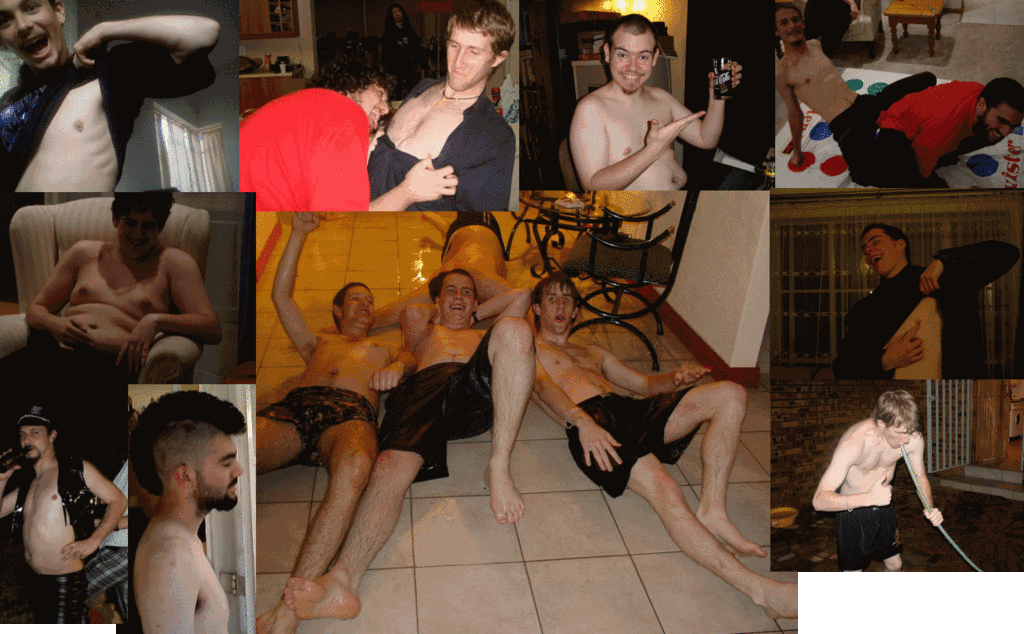
I completely agree with that core concept. If we claim to value gender equality (which we do here in South Africa, and which the US, where GoTopless originates, also seems to), then that needs to apply to all laws, not just the ones that a select group of people are comfortable equalising. And yet, I can post all manner of topless males here, from the artistic to the silly, and nobody's going to accuse me of spreading smut. Consider the following photos of me and some of my male friends, and ask yourself what exactly would make them so much more dangerous or revolting if we were all replaced by females, dressed and posed the same:


Any woman in South Africa who publicly looks like we look there stands the risk of being charged with public indecency, which is quite vaguely defined (though more specific, and more clearly biased, here) and may face a fine (R500, I believe). Even if she gets away with a warning from the court, it means she has a criminal record. For dressing and acting like we have above, but with one X chromosome too many. A criminal record. Like a murderer or rapist.

Of course, it's much easier for my friend to make that demand on Facebook, being a heterosexual female. As soon as I add my support, my motives are immediately in question, because surely I just want to ogle naked lady-boobs? Well, sure, they're often nice to see. But it's not just about that, and I don't think that's even my primary motive, because I support this right for all women, whether I find them attractive or not. To take the most extreme example, the person I least want to see topless is my dear old grandmother. But even she, I have to admit, should have this right, or none of us should (and I see no good reason why none of us should). It's also worth remembering that a right is not a requirement; not all males go topless all the time, so there'd be no expectation that females should have to too.

But what if I'm just saying all that as a gambit to get prettier women naked? It's not unreasonable to question my motives, no matter how earnestly I speak or write.

The conclusion we came to a month ago was that since my support can't be assumed to be genuine and serious from my word alone, I could/should make a more significant gesture to show how serious I am. And the obvious gesture is to get my own clothes off in solidarity. It took some thought to decide exactly how, though. I'm not opposed to full nudity, it's really not something that bothers me, but that might be too far for some to manage in one step, and I get that this is about equalising current laws, not completely overturning existing "decency" laws. But I can't just bare my own chest, since the whole point is that there's no big deal about male chests. I conducted a very small, informal survey, and it's surprisingly hard to get agreement on what a male can show in public that's equally "naughty" to a female showing breasts in public, according to both SA law and informal social norms. Someone suggested I flop only my scrotum out, but I think that's still too much of an overshoot. The closest male compromise I could find to female breasts is - and I freely admit this is still an awkward, uneven analog - the buttocks.

Here then are my pretty white arse cheeks, officially on public display for the first time, in support of gender equality, for whatever that turns out to be worth.

[This link contains my naked buttocks.] - Me in my natural environment. I'm glad that it shows all the details, nearly every spot, hair and squiggle - "warts and all," to borrow Oliver Cromwell's instruction to his portrait painter - because, in addition to showing how serious I am about this, I think a failure to be realistic about our bodies is part of the problem. My arse is not abstract or imaginary (probably the greatest line I can ever remember writing), and nor are any woman's breasts. These are real, present things, and to pretend otherwise is just silly.

[This link contains my naked buttocks.] - On the other hand, a blurry, detail-free shot like this illustrates the point that the basic form - a round mass of flesh - is pretty damn unremarkable, and it's only our arbitrary social conventions that dictate that a buttock is considered taboo in any way. Does the addition of a nipple to the same basic form make a female breast so much worse, when we've already demonstrated that male nipples are easily disregarded?

[This link contains my naked buttocks.] - And finally, the face to very closely match the butt. Part of the problem specific to female nudity seems to be that too much of our society is content to treat the female body as just a series of body parts, to be viewed in isolation. That's pretty dehumanising, and I would argue that there's a self-reinforcing relationship between this and the idea that females have to keep those virtually disembodied parts hidden, rather than requiring people to treat the whole female as a full person. If your only way to concentrate on face is to hide boob, then having to hide boobs makes them seem more different and distinct, making it harder to disregard boob, so that your only way to concentrate on face is to hide boob, etc. As I say, self-reinforcing and dehumanising. Rather just collectively get over it.

Am I advocating that all men hang their butts out for this cause? Yeah, if they like, I suppose. I'm not trying to start a movement, but I'm not going to panic and cry if anyone else repeats this exercise. I certainly wouldn't be the first of my friends to be bare-bottomed (or more) in public. This started out as just an interaction between a couple of friends, a personal gesture of support, and it's only here now because it's a gesture that relies on a certain degree of public performance.

Let me pre-empt some of the criticism I've already seen from more conservative types.
  1. "I don't want to be topless!" - Ok, don't be. Nobody's arguing that it should be compulsory, just that it shouldn't be prohibited either. It doesn't do any harm, so let other people live their lives how they like.
  2. "Aren't there more important issues to deal with than toplessness?" - You're fucking right there are! But on the one hand, if this is such a trivial issue, then why oppose it? And on the other hand, no degree of pointless, petty rules-mongering is acceptable. Yes, it's worse to say that women aren't allowed to vote with men than to say they can't get topless with men, but neither is fair or just. We can aim to fix all injustices, not just the massive ones. You can't end apartheid every day, as it were.
  3. "What about the children?" - What about them? Children don't have all your baggage and preconceived notions, they'll adapt quite well to whatever social norms they grow up around (this link contains naked breasts). And would you rather have them grow up around tolerance or discrimination?
  4. "It'll cause rape!" - No. Rapists cause rape. And I have worrying news: Rapists rape people in all states of dress. But if revealing attire really did correlate with the incidence of rape, shouldn't we ban bikinis and low-cut tops too? In fact, just to be completely rape-proof, why not go full Taliban on women and make total skin-covering compulsory, for their own safety? I don't think it's true that clothing and rape correlate, send evidence to the contrary if you have it, but that would be the logical implication if it were, once you start dictating what specific anti-rape precautions people must take.
  5. "People who want to get naked should go stay in nudist colonies!" - I don't want to go quite as far as comparing that with the Group Areas Act, since skin colour is completely non-optional, but it is pretty fucking arrogant to say that different people with different customs aren't allowed to live and practise those customs where you are, just because the mere thought of it offends you. But never mind full nudism, just focus on toplessness: This is already widely accepted in your area, it's just unfairly gender-biased.
  6. "Get your mind out of the gutter!" - I should also point out that going topless (or bottomless, for that matter) does not automatically mean you're after sex. I usually do it when I'm hot or uncomfortable, for purely practical reasons, but there are more dramatic non-sexual reasons (this link contains a topless woman but doesn't show much) for it too. And sure, sometimes it can be about sex. But not always, is the point. Regardless of the reason, if we allow it for males, we should allow it for females too.

Two closing thoughts. First, it's worth pointing out that GoTopless is a Raëlian Church (this link contains naked breasts) initiative. I don't think that undermines the inherent value of it, but I will insist on making it clear that I think Raëlism is whale-shit crazy. Not more crazy than talking snakes, people holding up a solid dome sky, magic underwear or invisible wish-granting beardy men, but still whale-shit crazy.

Second, in digging through a decade of old photos for the ones I used here, I was surprised (not completely surprised, but still surprisingly surprised) at how many photos I've accrued of friends' hairy balls. Perhaps getting comfortable with nudity is just a matter of practise.

Saturday, 18 August 2012

Fury at Marikana

We sometimes forget that police are only human, same as the rest of us. One of my older relatives happens to have been friends with a guy who was a cop stationed at Sharpeville back in March 1960, and it's illuminating to get an insider's perspective of what happened there. In short, the 20 cops there were completely shitting themselves, with up to 19,000 angry people only one flimsy wire fence away from them. They were all terrified, but the officer in charge insisted that they weren't allowed to withdraw indoors and had to guard the fence in some sort of ridiculous show of force. It was almost inevitable that one of them would panic, and panicky people with guns are a shit combination. The rest is now standard high school history.

Of course, understanding the cops' fear and panic does not justify the violence that came from it. The protesters were justifiably angry and justifiably unwilling to tolerate the presence of a police force that served primarily to oppress them, but even if their demands had been nonsense, if they'd arrived in their thousands and angrily shouted that all plus signs should sound more pepper, it would still have been wrong to open fire on them. This is because the core function of the police should be to protect the general populace. Maintaining and enforcing a narrow definition of "order", like well-armed nannies, is only any good if continued disorder is clearly against the public interest. When people rise up in a great mass, then they've chosen disorder for a reason, and that reason needs to be dealt with maturely, not shot at until it goes away. It's easy, in hindsight, to see why the villainous apartheid government had no interest in mature engagement; they weren't interested in serving the general populace.

(Out of interest, this cop who was my relative's friend apparently quit the police immediately after the Sharpeville massacre and became a nervous wreck of a car mechanic instead, still only in his early 20s. He was only human, after all.)

52 years later, and we have another, fairly different massacre by the police at the Marikana mine. Not all the facts are in yet, but it's different in a few obvious ways. First, the cops there weren't nearly as badly outnumbered, with something close to even numbers of cops and striking miners. Modern cops are also much better equipped, with body armour and a variety of non-lethal devices. Second, this wasn't a sudden one-day event, but had been building up over at least a week. This meant the cops had much more time to prepare a response and diffuse the situation peacefully, but also seems to have given them more time to get scared, jumpy, paranoid. This is because, third, the miners here hadn't been quite as peaceful as the residents of Sharpeville, with several incidents of violence and murder, plus lots of posturing with sticks and other cheap melee weapons. I can't condone that. But I also can't accept that 3,000 people all murdered only 6, or even that most of them would have, given the chance. They are all human, after all.

Fourth, media coverage was better this week, and the massacre itself was well documented. I don't feel like linking to the videos here, because it's just horrible to watch. If you feel you need to see it first-hand, it should be easy enough to find on various news sites. In summary, a group of (I'd estimate) 50-100 miners came rushing down the small hill where they'd been camped towards the police and, with about 100m between the two groups, the cops opened up with a barrage of live rounds, several using R5 rifles, directly into the group of miners. It's clear from the video that, with the speed at which it all happened and all the dust that was quickly kicked up, nobody could effectively aim at any specific targets, and with the sheer number of bullets flying, most of those miners were hit and at least 34 are now dead and 78 injured.

Again, not all the facts are clear yet, but there are a few possibilities. As far as the miners are concerned, it's possible they were genuinely attacking, somehow deluded into thinking that a long history of missile weapons trumping melee weapons in headlong charges wouldn't apply to them. It's also possible that they thought they could just scare the cops off without having to fight. Both would be stupid decisions with the full benefit of hindsight, but it is possible that they felt cornered and desperate enough to be stupid, since the police had earlier openly threatened that they'd not tolerate the miners' presence any longer. And it's possible they were just going to put on an angry song and dance for the news cameras, symbolically undermining the police presence. I don't know which of those is true, or even if it was something else entirely. And if I, with the benefit of multiple replays from multiple angles while sitting in the comfort and safety of my own home, can't even begin to guess, then I can't see how the cops could have known any better in the few seconds they had to react. I doubt they would all have been thinking the same thing, and there may have been similar ambiguity among the miners about why they were coming down the hill.

But similarly, it's hard to be sure what the cops were thinking. Some blasted away like mad, while some didn't seem to fire at all, standing in place stunned or ducking for cover. If there were any warning shots fired by the police, they were drowned out by the lethal ones. After a while, someone started calling for a ceasefire, which not all the cops were quick to adhere to. There was reportedly a total of 2 or 3 minutes of major gunfire, so there must have been more shooting beyond the footage I've seen. And I'm also told, though haven't seen it myself, that there's footage of one cop vomiting, possibly from the stress or the shock or the gory aftermath. There's a lot of unknowns in that, but it seems clear enough that the cops were surprised and not well coordinated or disciplined enough.

I would like to suggest what I feel is a likely course of events: The miners rushed down the hill. The surprised cops shat themselves and opened fire in panic. Over 30 people died. That is all.

There's been a lot of talk about who fired the first shot. It's not clear in the footage I've seen. I'm not sure it matters in the big picture. The vast majority of miners clearly didn't have guns, hadn't had guns all week, which means any shots from their side, whether accidental or posturing or intended to harm, would have come from a small minority and the reaction against them should have been equally limited. Opening fire indiscriminately on the whole crowd was guaranteed to kill innocent people. Similarly, there are claims that grenades were thrown at the police, but nothing explodes noticeably on the videos, and even if a dud was lobbed, it couldn't have been lobbed by all 50+ of the miners. More likely, I'd guess someone threw rocks. And if the miners definitely didn't shoot first (or perhaps at all), then the police simply shot first and thought later.

Absolutely none of that is behaviour I'm willing to tolerate from my police service.

I can understand the fear those cops must have felt, but it doesn't excuse a blind-panic massacre. At worst, those responsible should be charged with murder, and at best, they should be sacked (if they don't break down and quit first, like my relative's friend). They clearly can't do the job properly.

This is not to say the violent strikers are forgiven. They allegely killed 6 people directly and thus bear at least some responsibility for the deaths and injuries of many times as many more, whether they sparked the massacre on Thursday or merely swayed the situation towards it. This minority really needs to face the courts, and the rest of the miners should seriously consider turning their violent colleagues in, partly to earn public trust and partly because it's the right thing to do. And while I can understand their need to show some symbolic strength by talking big and carrying those sticks and knives around with them, it further depletes the public perception that they're the victims getting fucked over, and it gives the bad seeds the impression that their violence is widely accepted, which it shouldn't be. But I don't think either of those steps are likely to be taken now; they're too full of fear, anger and testosterone.

At the same time, I do sympathise with the majority of striking miners who refrained from violence. They earn no more than R4,000 (US$500) a month, which is not a proper living wage, especially for what is undeniably hard and dangerous work. I make about the same - though working far fewer hours and in relatively luxurious surroundings; I have a chair and a window with a nice view of trees - and I can't live independently on that (I'm lucky enough to have parents willing and able to help me out; this is rightfully their internet I'm writing on). If I had even one dependent to pay for, as many of the miners (many humans in general) do, it'd be a total joke of a salary. The miners' demand for a real salary, <sarcasm>to make as much as those terribly overpaid professions like teaching and firefighting</sarcasm>, is perfectly fair, especially when you consider that Lonmin, their employer, had a net income of US$321 million last year. They had 27,800 employees. My accounting is rusty, but isn't that over US$11,000 net income per employee, or more than 11 times the increase the miners were asking for? So the money is definitely there. Where does it go? You could look at Lonmin's CEO, Ian Farmer, who pulled close to US$2 million from Lonmin in one year, or over 300 times as much as the miners who do almost all the real work in this mining company. I wouldn't put all the blame for the workers' shit salaries on Farmer alone, though. That wouldn't be fair, I just picked the CEO first as an obvious example of a big boss. There's a whole bunch of those overpaid shitheads to pick from.

A lot of people on all sides have done horrible things here. But I think the greatest part of my fury is reserved for the senior ranks of the SAPS and the government officials above them. I may not be an expert on policing, but I do happen to know a thing or three about conflict resolution, and the SAPS has shown no interest in applying or participating in anything more than bullying people into "order". And I don't just mean this week at Marikana. Heavy-handed "shoot to kill" policing has been actively encouraged and there's been a big push to re-militarise the SAPS away from the civilising changes of the late '90s, coming down from the highest levels of government. As public protests (mainly over service delivery, which I've been meaning to write about in detail for months now) have become more frequent, so have the stories of police employed to do little more than suppress the protests, sometimes crudely and dangerously, occasionally lethally, not to mention the almost routine police corruption at all levels, from junior cops harrassing random pedestrians for bribes to the most senior police officials pocketing huge kickbacks. I sometimes feel the whole rotten institution should be disbanded and rebuilt from scratch with all new people, chosen for different traits (e.g. not being cowboys) and trained in a different direction, but there are other factors that need fixing first, or that'd just rot too.

My point is the senior police should either be broadly trained and competent enough themselves to think of something smarter than "threaten the angry crowd of thousands who've been saying they're willing to die for their cause," or they should at least have the resources and humility to bring in someone who can have those super-challenging creative thoughts for them. I could do it if pressed, but I'm really far from being the most highly-qualified conflict resolution expert. Why wasn't someone far smarter than me put in charge there?

This may have degenerated into a bit of a ramble, but I'm pissed off. It's bad enough that people suffer and get killed, but to see it defended on the news as 'necessary' and 'legal' and in any way acceptable is infuriating. To return to the top, though, we sometimes forget that we're all human, we all fuck up. I can put myself in the miners' shoes, I can put myself in the cops' shoes, I can see how they might have done horrible things without trying to be horrible. I struggle more to sympathise with the Lonmin executives and SA government and SAPS officials who caused the whole fuck-up in the first place, and I think that difference is interesting and important. The conflict on the ground was something very real and tangible; we can all imagine being shit-scared or desperate, we all know how irrational these base emotions can make us. But I can't imagine coldly making my fortune by ripping off thousands of other people or giving orders to crush the people I'm paid to care about. I'm not a perfectly nice guy, I'm also only human, but perhaps those sorts of things are not among my normal range of evils. I hope they're not.

Fuck it all. Let's at least learn the right lessons from all this.

(EDIT: For late readers looking for a more up-to-date picture of what happened, I've found this to be an interesting read.)