Thursday, 24 September 2015

WIP House Rules: Star Trek Next, update 1

For the last year or so, I've made very little progress on my promise of a Star Trek adaptation of the D&D 5th Edition rules, mostly because other things got in my way, but at least this gave me plenty of time to think it over. And especially in the last couple months, I've been increasingly of the opinion that it was all a bad idea in the first place. Still, I offer my work thus far for public scrutiny and discussion. Perhaps my concerns can be resolved.

Rise to Glory, by Jetfreak-7
The little document I've scribbled up so far covers everything I set out to sort out when I last posted about this, and it's probably just barely playable as is. I got a little lazy with the gear, but Star Trek isn't very equipment heavy, usually. I also haven't included much about starships, as I'd been working on that inside of a big spreadsheet of ship stats I've been messing around with across multiple rules systems for years now. I did at least prepare sample Federation and Klingon ships, to give a rough idea of how they'd look under the current rules. It's all just far enough to be play-tested without much wasted effort.
I probably put more time, over several years, into those two ships and the mini-campaign they're intended for, than into the main rules document so far.

But I kept stumbling across the same big problem, over and over, and initially I took it to be just variations on the relatively minor problem I found with Star Trek's energy weapons. I thought there were just some combat balance problems, until some people got me thinking that actually perhaps the real problem is trying to put a full combat system into the game at all. Fighting is not unheard of in Star Trek, but it's almost never the main focus, and when it is, they seldom bother with realism and balance. This is why it's so hard to get players to behave like Starfleet officers (in my experience): The rules systems always reward them for thinking hard about how to fight, in ways that the series generally wouldn't bother with. At the same time, the formal rules as written don't do much to encourage science, exploration or diplomacy, which are obviously the main activities of any typical Star Trek episode.

It could be argued that the GM, via the scenario, should set things up to keep combat minimal, and that players should naturally want to play in a trekkish way if that's the game they choose to play. But it's also pretty well established that players and GMs will tend to fill out the space the rules encourage most. This is partly laziness, partly trusting the designers, partly getting tricked by relative rules emphasis. The existing Trek rules (FASA, Last Unicorn, CODA, d20) all have multiple chapters on how to resolve personal and starship combat, but scant advice on how to craft or resolve a scientific mystery or a complex and interesting hurdle to social justice. If you're trusting their rule books to guide your scenario or character creation, it takes quite a lot of focus to keep youself from including all that fighting stuff.

I started trying to fix this in my Star Trek Next rules by cutting back on combat, by resolving fight scenes as a whole instead of playing them out round by round. Even Call of Cthulhu, renowned for being a game where guns are futile against unimaginable horrors and which is already equipped with only a very rudimentary set of combat rules, still plays out its fight scenes round by round, imitating the war game roots of roleplaying. So dropping that totally is an unusual step for me, but obviously right, now that I've seen it. Star Trek fights on screen are never about who has tactical advantage or what the equipment can actually do (otherwise, the Borg should never lose); they're just a means of moving the plot along, boiling down to "X is in trouble" or "Y will be difficult to talk to" or "Z aims for ABC ideals". They're seldom fights to the death, and they are seldom resolved purely by combat. They're just a setup for something else.

(There are exceptions: The Dominion War featured lots of pure combat scenes, for obvious reasons. But even then, DS9 still used the warship Defiant in many, many non-combat roles too. The Earth-Xindi War too was resolved with a little bit of shooting and a whole lot of talking, negotiating, investigating, understanding, etc. The movies tend to be more action-driven and feature more traditional fight scenes, but these are either lame and pointless (e.g. Nemesis or the 2009 movie) or are actually very well written underneath as metaphors and symbols for deeper issues. Wrath of Khan, traditionally, is held up as the perfect example, and yet I've heard recent viewers complain that it's so slow. Well, it's slow because it's not just blowin' shit up for no reason, it's playing out an extended dialogue between Kirk (representing the Starfleet ideals) and Khan (representing the opposite ideals), with torpedoes as punctuation. That battle isn't just about who wins and who loses, but about who they are and why we should care about them. The same is true of the dialogue-heavy lightsaber duels in the original Star Wars trilogy vs. the frantic-yet-dull epilepsy-inducers in the prequel trilogy. "Luke, I am your father" was not preceded by 20 minutes of flashing rainbow disco.)

So reducing fight scenes down to, "Players, what do you hope to achieve at the end of this? GM, what do the NPCs hope to achieve at the end of this? Let's quickly see who gets their way and what it costs", is my way of making the roleplaying rules reflect (most of) the TV series better.

But cutting that back leaves a bit of a void, and I'm not yet sure how best to fill that with more Trekkie sorts of activities. I've seen investigation done well in Call of Cthulhu, Delta Green and Warhammer, but I don't think I've personally mastered setting up a good mystery. So I need to study that a lot more before I can decide how best to implement rules that will encourage and support it well.

One trick I have picked up is a style of roleplaying scenario that's essentially one giant puzzle, which is good for more technical engineering or diplomacy stories. The GM only needs to set up a situation where there is a single, major technical hurdle to overcome, and then sit back and give the players free reign to prod at it and discuss it and try things. The GM should understand the pieces of the puzzle very well, in order to answer questions about it appropriately, and should have a good sense of what is and isn't possible with it, but should avoid being too prescriptive about their expected One Solution. Rather, it's a chance to let players get creative and personally involved in a challenge. Their solutions can be very surprising in the end. I've seen this work very well in a lot of games, but it seems to fit Star Trek especially well. So I'll certainly try to make my rules accommodate that sort of thing. But I'm not sure yet what other elements to add in.

I'm also unsure now if D&D really is a sensible foundation to build my rules on, considering how combat-focused it is. The core mechanics are nice, though, and I may still want to use them, but its looking increasingly like I'm going to have a very mutated system in the end.

Please feel free to try out my rules thus far and comment on any useful changes you can think of, or bits you think should definitely stay.

Sunday, 30 August 2015

Whatever Happened to the Sci In Scifi?

[EDIT: This review can now be considered a part of this longer set of Fan Trek reviews, which I started working on after this post.]

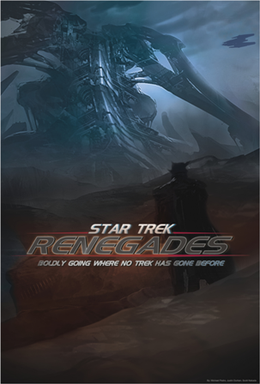
I've just watched Star Trek: Renegades, and it's certainly better than the Abrams movies in many ways. That's an accomplishment of note for a fan-made, crowdfunded, feature-length thing with a fraction of the budget of the official, canon movies. But I still didn't think much of it; it seems to be yet another production that doesn't actually understand the central premise of the Star Trek franchise.

There will be some spoilers below. You should watch the movie, then come back here to pick it apart with me. Because it's not a terrible movie - it's definitely watchable - but it just doesn't meet my personal standards for a good Star Trek movie.

Let me start with the positives. It looked right. It's hard to put my finger on exactly what made it, but the visual style was all right, somehow. I read a thing about how the production designers at the start of DS9's run faced a challenge with making their Cardassian-built (and therefore non-Starfleet) space station look alien and yet still recognisably part of the same setting - and they did successfully pull that off. I would guess there was a similar challenge with Renegades, making a pirate ship look specifically like a Star Trek pirate ship and a bunch of offices on Earth look like Star Trek offices.

The other vessels, the Starfleet ones, worked well too, though that was a lesser stretch. The uniforms were different, but that's as good as Trek tradition now. Uniforms are not very uniform. I gather a lot of this was borrowed from Star Trek Online's visuals. The alien ships were the usual, meh, but we see so little of them that this makes no real difference.

The special effects were fine, considering the budget, but sometimes jarringly inconsistent. Ship exterior scenes worked well, because they were pure CGI, which mastered showing us spaceships years ago. Simple interior scenes worked well because they were mostly physical sets with little to be added. The awkward ones were the more actiony green screen scenes, where lots of extra stuff was added, not always cleanly. The random spurting background fire, early on, bugged me the most.

The selection of characters was great. As an anti-hero crew, they were a good mix of interesting concepts, borrowing cleverly from established canon without being unoriginal about it. There was clearly a lot of thought spent rounding each one out behind the scenes. They'd make a great roleplaying game party. Unfortunately, we barely get to know them once they're on screen, and they might have done better to trim a few off and focus on establishing a smaller number of characters more deeply. The older characters brought over from the official series fitted in well (even if I don't like how they changed Chekov, he's still believably Chekovian), and the experienced actors taking on new roles also clearly knew just how to make their new characters fit in. The only negative I noticed with the cast is that there was a noticable quality clash between the top experienced actors and the less skilled (maybe amateur?) ones. Nobody was actually completely terrible, but the difference in skill was stark enough that it reminded me just how important good actors are. And official Star Trek has had some excellent talent over the years.

Now, on to the serious negatives.

I didn't like the plot, and that's no small thing. The setup was interesting (an entire new major power just suddenly appearing within known space), but then the villains were pretty flat. It seemed like their strange arrival was linked to their motives, but this was covered in a single brief villain-monologue, rather than explored in any depth. So, they might as well have just been normal aliens who lived normal alien lives out beyond the fringes of Federation space, until they were encountered in the usual manner. The magic world-teleportation was a flimsy gimmick, but I'll explore that more later on. For now, I'll just say it added little justification for the aliens to be generic two-dimensional bad-guy bug-eyed monsters.

But it's worse. This sort-of interesting initial hook could still have been turned into something good, and instead it's used to kick off what I can only describe as a stereotypical 21st century American conservative war-fantasy. Not only does the ruthless dictator (and his pure-evil monster-people) actually have weapons of mass destruction (for realsies!), making him an actual, direct threat to Earth's homelandworld security, but the ever-ineffectual Big Government in the Federation Council can't and won't stop him, so it's up to people with lots of guns to disregard diplomacy and ethics. I'm only surprised they didn't put a computer-animated Ronald Reagan in the captain's chair and unfurl a "Mission Accomplished" banner in the shuttle bay at the end (or halfway through, rather).

And so our "heroes" are really just brutal killers, totally uninterested in interstellar diplomacy or the ideals of the Federation. I get that anti-heroes aren't supposed to be clean and squeaky, but beyond a certain line, you're not telling a Star Trek story anymore, just a story that happens to be set in the Star Trek setting. And I don't think Roddenberry would have recognised this as anything like his ideals.

It goes beyond the rogue crew, too. Chekov, dear old Chekov, has apparently been replaced by his Mirror Universe self, and thinks nothing of ordering assassinations. My guess is that they wanted to have Koenig's Bester character instead, without bothering to explain why Chekov is now acting so un-Chekovy. Tuvok, always the more complicated True Neutral secret agent, is a little more believable behind dubious dealings, but I would have thought he'd have learned to Not Be Evil from Janeway. And bringing back Section 31 as his baby is super dubious. The whole point of Section 31, as portrayed in DS9, was that, yes, unethical means might get the Federation what it wants, but it's not the way the Federation (as represented by Starfleet) wants to be. They were written specifically to demonstrate that the ends do not justify the means, because Star Trek ideals are as much about the means as the ends. Section 31 is rightly treated as a bunch of villains, and it's risky bringing them in as supposed good guys now; I certainly wasn't sold on their sufficient necessity, let alone goodness, in this movie. Where was their stealth diplomatic mission, aiming to undermine support for the evil dictator? If all the aliens are equally Evil, then how does killing just the one leader help? Won't his successor just keep trying Evil things? And why didn't they just steal the alien WMD, both protecting the Federation and giving them a new kind of toy to study? "Kill da baddies!" is such a simplistic, lazy plot, both from a story-telling point of view, and from a realistic international relations point of view.

The sole conventional Starfleet captain we see, Alvarez, is an asshole, also apparently capable of nothing more than shooting stuff. I get that he's filling an antagonist role, so we're supposed to side with the Icarus crew over him... except they're all equal assholes and I didn't want to side with any of them. Alvarez looks like a total fool when compared against Kirk, Picard, Sisko and Janeway. I did think, while watching his scenes, that he was just about the right age to have been a young officer during the Dominion War, and that might explain his more aggressive demeanour later on, but the movie never even tries to explain him, and his much younger crew all simply bow to his orders (with one brief exception), so it's hard to excuse. The Starfleet I know wouldn't have promoted someone like him to captain.

The science in this movie was also apparently not considered at all. It's an old joke that Star Trek's science is always wonky, but at least they always used to try, often with slightly cheesey analogies to link audience understanding with this stuff even the writers aren't supposed to understand properly. (Analogies are actually a great tool in real-world science education too, so I think traditional Trek handled that well.) This one isn't even trying. It makes sense that 24th century technology could be super-science to us, virtually magic. But it shouldn't just be magic to the characters in the 24th century, and they should give the impression that they know how things work. Renegades, unfortunately, does slip into treating technology as magic a few times. We aren't given a techno-babble explanation or analogy for why the magic alien obelisks do what they do, they just do shit. And apparently hacking isn't a branch of computer engineering anymore, it's literally magic brain telepathy.

There's much less to say about the bad science than the over-reliance on violence to solve problems, and that ratio says a lot on its own. This is supposed to be Science Fiction. I've read, watched, studied and even created enough scifi to understand perfectly well that scifi doesn't have to be all hard physics, all the time, and I personally really enjoy scifi that leans more on the social sciences. It's really fun and useful to be able to play what-if games with whole societies and see if we can work out how life might be different if XYZ were a thing. Star Trek did just that for decades, not only looking at what we might be like with warp drives and phasers, but with a post-scarcity economy and universal equality (or as close to this as its writers could get). Renegades seems to have been written by people who were blind to all of this, unless they were trying to get us to imagine a what-if world in which Dubya Bush was right and Saddam really had nukes and the intent to use them against the US mainland (as well as the places where America gets its fuel) and ruled over a culture of warlike savages who cared only for blood and battle and couldn't possibly be reasoned with. It has no more political depth than a Star Wars movie (and I don't mean Empire Strikes Back).


I'd be prepared to believe that, behind the scenes, a lot more thought went into all of this than we see on screen. The character backgrounds, for example, give a lot of indication of brimming over with stuff we don't get told explicitly. And the magic space menhirs may well have come from somewhere exciting, by some interesting means, and operate in a technically interesting manner. They may even have a semi-decent excuse for the telepathy-hacking. But, crucially, none of this actually makes it onto screen, and that's the sort of stuff that always made real Star Trek great: Not just showing the audience shiny, flashy lights, but trusting that the audience is smart enough to be interested in the explanations for the shining and the flashing. Assuming your audience is dumb and impatient is the same assumption the Abrams movies made, and it's a self-fulfilling assumption, because it bores more engaged audiences. I'm pretty sure that taking the time to explain the Syphon situation more completely would have been more interesting, and would have unearthed alternatives to mindlessly killing the mindless killers. Roddenberry's ideals aren't just nice ideals to live by, they're also a mine of good story potential.


It also annoyed the fuck out of me that Renegades resorted to the Disposable Woman trope, in order to give the Singh character... something? A weird poem? Motivation? I wasn't even clear why they'd bothered to write that part in, given that the Singh character also apparently gets sufficient motivation just from wanting to avoid the rape-gangs that are implicitly condoned conditions for a Federation citizen in a jail (was it a jail?) that is evidently somewhere in or near Federation space. It's an unfortunate double dose of the sort of bad writing that treats the serious abuse of women as a casual one-liner to drop in as a cheap, lazy signal of edginess and grit. Of all the character backstories, I was most interested in Singh's, but we actually get very little of it, because we're supposed to take the single phrase "escaped rape-gangs" as a full story, when it clearly isn't.

I really think a good Star Trek anti-hero story is possible. The Maquis, old favourites of mine, illustrated this wonderfully. They had a good, solid reason for choosing to abandon the rule of law and embrace violent means, and even then we aren't supposed to take it for granted that they're always in the right. They were properly complex and that made them very interesting. I was disappointed that Renegades failed to live up to that level of complexity. There's talk of making more, of turning this into a new series. As a serious Trekkie, I'd be very happy if a new series started up, and this one definitely has a lot of potential to be good. But, I do need the writers to up their game a lot. Put some science in it. Take out some guns. Make it nerdy and idealistic, and show you actually like Star Trek, not just the money Trekkies will give you for putting the right label on a production.

=^=

A couple small quibbles, while I'm here, and be warned that these are even more spoilerish than anything above, though probably also less crucial to the plot:

Why did the engineer, Doc, wear reading glasses? It's been long-established in Star Trek that most eye problems can be permanently corrected, that this has been so for centuries now, and that absolutely no Federation-born human needs glasses any more. Even total blindness can be fixed! It's a medical anachronism as odd as seeing a modern sailor with a wooden peg leg and a hook for a hand. It instantly jumped out at me as weird.

Why did the hand bomb have to be painfully phasered off and only teleported away to safety after that? Wouldn't it have been safer, cleaner and far less painful just to teleport the hand off directly? Or even just to teleport the bomb out of the hand? And why would Starfleet HQ only have bomb sensors right next to the admiral's desk, but not in any of the doors and corridors you'd have to pass through on the way to his office? By the time you know the bomb is right next to the admiral, it's probably too late to protect him from it.

Who was the random academy friend of young Cadet Chekov? She's in a bunch of scenes, she gets a talking part, and yet does absolutely nothing for the story. Some sort of crowd-funding gimmick, maybe? Surely, whatever the reason for adding the character, they could have given her more to do than just stand there and be impressed to be near (the Mirror version of) Chekov?

(EDIT: I quite liked this guy's perspective on Renegades, even if he doesn't express it with perfect eloquence.)

EDIT:
I've just caught up on the predecessor movie to this one, Of Gods and Men. It's not a prequel-sequel pair, but they're written by the same people and produced by many of the same people. It even has a lot of the same cast in common, as well as the mighty Nichelle Nicholls. And it's boring as fuck. The plot is ridiculously convoluted, and as near as I can tell this was only done so that they could cram a huge pile of early TOS references into the future. It feels awfully similar to the crude shoehorning of plot we saw in the 2009 Trek movie. (The way they treat Vulcan also looked suspiciously familiar.)

OGAM shares Renegades' militarism, with the sort of mass fleet battles that seem common amongst people who thought that was the exciting, interesting bit of DS9's Dominion War phase. In a plot already stretched across twice as many minutes as it could possibly justify, all these long battle scenes add is yet more tedious waiting for something worthwhile to happen. And they don't even have the better graphics that Renegades has.

They wasted some really quality acting skill. And to add insult to a different sort of insult, half the gag reel at the end is just pervy shots of the excellent Chase Masterson in a skimpy outfight. Not funny stuff, not gags for the gag reel, as was the case with all the other actors. They literally just wanted an excuse to put cleavage on screen. It's extra dissapointing coming from Star Trek fans who ought to get the whole equality thing.

On a more positive note, though, the uber-Trekkies at Women at Warp reported recently that Melinda Snodgrass, the very, very good writer of several of the best Star Trek episodes, has been brought on to write for Renegades in future. And since the shit writing is what I'd call their absolute biggest weakness, then this could well save the concept. Snodgrass really gets Trek, I have no doubt she can make good use of this new platform too.

At the same time, it was announced yesterday that there will be a whole new official Star Trek series launching in 2017. It'll be interesting to see how it compares with the many fan projects that have filled the void since ENT was cancelled. I hope they're not going to take this sort of thing as a model of what Trekkies want.

Sunday, 23 August 2015

Education/Astronaut Analogy 47B

This post is mainly sort of a reminder to my future self, an idea to develop, but I welcome additional input too. I spend a lot of time thinking about teaching, and a lot of time thinking about space stuff, so it's inevitable that I'll mix them up from time to time. Timmy is bound to get back from geosynchronous orbit sooner or later.

Basically, it's an analogy, and I've spent perhaps too much time trying to make it work, when it really doesn't stretch that far. But, as with any analogy, it works fine within the limits of what it is supposed to cover, so long as you know where those limits are and why they won't stretch further. You, analogy. That thing.

It goes like this: Basic education (what the Americans call K-12) is like NASA's human space program of the 1960s. It starts off with Mercury, barely leaving the planet at all and achieving very little, apart from figuring out that it can be done at all and identifying who's going to have serious problems and who's going to fit right in. That's like early primary school. Then you get late primary school and early high school, which is like Gemini. You're now trying to achieve specific goals, not for their own sake, but as stepping stones to later, real goals. You're mainly trying to learn the skills you'll need for later, including how to work together with others. Then late high school is like Apollo, with emphasis on a single, clear end goal: Landing on the Moon and/or passing the final exams.

I've made the analogy more specific for my grade 12s, linking their June exams with Apollo 9 (a chance to see how they'd cope with all the necessary elements of the final exam, but in a safer, more familiar context), the prelims with Apollo 10 (a full-scale dress rehearsal of nearly every aspect of the final goal), and final exams as Apollo 11 (the big thing).

And then, just like post-Apollo NASA, you face the uncertainty of what to do next. Do you build sensible space stations? Move to Mars? Figure out how to work internationally with other programs? Abandon space and stay home with your parents for another century? It's a great luxury to have a choice like that, and also terrifying.

Monday, 10 August 2015

Two Roleplaying Cows

I need to blow off a little steam, there are no interesting space launches for another week, and so it's list-making time again. So, with low-grazing non-fruit in mind, I offer my rebuttal to Robert Wiesehan's "Two RPG Cows" bit. I'll skip the graphics, as that's not my area, and instead focus on silly roleplaying jokes about the rules systems I know and care about enough to laugh about.

The D&D family:

Advanced Dungeons & Dragons, 2nd Edition
You have two cows. One is magic, but becomes entirely useless once it's used its spells. The other has the Etiquette non-weapon proficiency, but never has any opportunity to use it.

Dungeons & Dragons, 3rd Edition
You have two cows. You've calculated and listed and added up their modifiers and sub-modifiers for everything, including things that they can't do, like flying and talking.

Dungeons & Dragons, 5th Edition
You have two cows. One of them has an Advantage over the other.
 
Forgotten Realms variant
You have two cows. They graze on a very well mapped paddock that everyone's seen at least once, and one is a Zhentarim spy.

Planescape variant
You have two cows. I mean, they're basically cow-like, they fill all the usual cow roles; they just look weird (probably with blades coming out of them) and have a different name, and are vaguely tied to some specific pseudo-philosophical dogma.

Spelljammer variant
You have two cows. You raided them from a magic sailing ship in space. Possibly a cow-shaped ship.

Dark Sun variant
There are no cows. You have sand.


Other games (in no particular order):

Star Wars (any of the various systems)
You have two banthas. The force-using bantha has no need of the other one (and the farmer can't control it after a while either), but they always travel together anyway.

Vampire: The Masquerade
You have two cows. They wear a lot of leather, in a very obvious, intentional irony. If the farmer doesn't give them enough other farm animals to pick on, they turn on each other. The Malkavian cow wears a horned Viking helmet.

Champions (possibly also Mutants & Masterminds)
You have two cows. One is fatally allergic to milk and has a calf dependent on it, the other has a phobia of grass (ever since its parents were killed by it). Consequently, they live in the middle of a busy urban area, using modern urban conveniences to totally ignore their tragically flawed bovinity. They wear spandex, have amazing abilities, and probably never kill anyone.

Call of Cthulhu
You have two cows. They are both entirely ordinary. They visit a small seaside town, one is never seen or heard from again, and the other returns with Mad Cow Disease.

Delta Green
You have two cows. They both work for the government. They visit a small seaside town with a huge arsenal in tow, and refuse to ever let you know anything about what happened there, for your own good.

Star Trek (any of the various systems)
You have two cows. Initially, the fact that they are cows is their only distinguishing feature (apart from whether they wear red, yellow or blue), and so they're terribly ill-suited to flying the starship they're aboard. Very quickly, they become so skilled at so many different things that the fact that they are cows becomes irrelevant.

Kobolds Ate My Baby!
You have two cows. You eat one and are stampeded to death by the other. All hail King Trog!

Fallout PnP
You have one cow with two heads.

Spycraft
You have two cows. One carries an M4A1 with ACOG 4x scope, AN/PEQ-2, assault sling, M9 bayonet/survival knife, full tactical body armour and night camouflage BDUs. The other wears a tuxedo and carries a silenced PPK. Each cow feels that the other has missed the point.

Legend of the Five Rings
You have two cows. One understands all the cultural mores of Rokugan and rigidly follows its place in the clan and caste system. The other thought this was just kung fu D&D and quickly breaks every taboo possible.

Buffy the Vampire Slayer
You have one special, super-magical cow that really doesn't need anyone else, as well as any number of other, normal cows.

Warhammer Fantasy
You have two cows. One is secretly a Chaos cultist, the other is little more than a common outlaw in practice. Between them, they have two functioning limbs and an eye.

Dark Heresy
You have two cows. Neither can be trusted, yet both must be relied on to overcome a greater evil that threatens a scarred, failed version of the future. It's all very serious.

Paranoia
You have two cows. Neither can be trusted, yet both must be relied on to overcome a greater evil that threatens a scarred, failed version of the future. It's all "very serious".

Rogue Trader
You have twenty thousand cows. They're the best, most powerful, cybernetically enhanced cows money and influence can buy. You still have to do everything yourself.

Torg
You have two cows. Yesterday, they were cowboy-cows. Today, they're space cows. Tomorrow, they'll be magic cows in Papua New Guinea, circa 1985.

Monday, 6 April 2015

You're All in Space 1: Initial thoughts

My growing interest in astronautics history and too much time away from the GM screen over the past year have combined to get me thinking in odd new directions, all the crazy way into wanting to create my own setting. I have not done this before, successfully. I've barely doodled around the edges of it, always preferring to insert my own stories into pre-existing settings, with only some light customisation. Settings - the good ones, at least - look like a lot of hard work. This may end up going nowhere, but it may yet.

What pushed me into it now is that there doesn't seem to be a good roleplaying system or setting based around realistic, nearish-future space flight, with conventional rockets and conventional rocket science, and no super-tech cheats around the annoying (to some) but interesting (to me) problems of real spaceflight. I want a setting with travel analogous to early sailing ships - something as basic and fragile as Greek triremes or Viking longboats - in the interplanetary vacuum. Capturing the technical challenge and subsequent feeling of accomplishment, if not the fiddling detail, of Kerbal Space Program seems like a good sub-goal for me.

I have not yet found a good system or setting that I can steal for that, so I guess I'm making my own. I've got this rough idea for very simplified, boardgamish orbital mechanics that'll do for long-distance interplanetary travel, but not so much for small-scale spacecraft interaction. Then there's every other rule in the game. I do know that I want pretty lethal combat, especially with the very fragile spacecraft. Armour could be a thing, but physics will make that a very expensive addition to actually move around anywhere.

Second, I want a setting that focuses on the wrongs of imperialism, but again, in a realistic, historically-minded way, not the generic "bad guy because we say so" Star Wars-type caricature of empire. I don't like that, because lazy good-vs.-evil absolutism is inevitably just an excuse for unapologetic violence as the only solution, a la the stereotypical "good-aligned" D&D mass murderer. I want my empires to be a legitimate source of trouble for the players, but I want to make them believable, substantive empires. There have, of course, been historical examples of truly vile, evil imperialism, but it's simplistic to assume they're all bad in the same way all the time.

I also don't want to directly rip off specific historical cases of imperialism, partly to give me room for creativity, partly because it doesn't feel right. I'd like to apply some lessons learned from history (The Scramble for Africa is the single biggest foundation I have in this area, and Crash Course History is adding a lot), but any future scenario is bound to have its own unique wrinkles.

Asteroid with party hat
That said, I think it'd be fun to bring in some familiar local flavour, so for my "home town" entity, the presumed starting community the typical player character will come from, I'm thinking of an asteroid-mining colony originally populated mainly by Joburgers. We're not a bad source for people experienced with deep shaft mining, and the support systems around that. I have other ideas too, but those will be speckled with Joburgish bits.

I picture this colony as one of several of a first wave of technologically similar but culturally varied outposts set up on asteroids, moons, Mars, maybe further. Each would have its own flavour, it's own way of doing things, it's own strengths and weaknesses. Then the second wave arrives, a generation or two later, when a bunch of gravity-loving Earthicans with greater numbers, more advanced tech and little idea of the nature of colony life, start trying to compete with each other to take direct control of as many established colonies as possible, for their own purposes, trampling on first wave colonists' customs and rights and such.

I imagine the main focus for an adventuring party would be trying to get by in the way they were used to, with the threat of imperial interference or worse, escalating perhaps to falling under full, direct imperial control. The basic types of adventure for the party could include things like exploration for new resources (or if things get really bad, new homes), trade and negotiations with other colonies, investigation (there's always room for generic investigation of something or other), and eventually whatever resistance against second wave disruption comes up. Naturally, as with any good adventure in any setting, things won't always be as straightforward as those basic skeletons of ideas, but the specifics are not the sort of thing a GM should publicise. Also, I haven't yet thought the specifics through that much.

Finally, I want it to be an optimistic game, over all. Sure, there's this growing outside threat and it'll be a rough life to start with, but I'm done with grim, dark stories all the time. It's been done, and it doesn't really add anything I want. The players in this game will have a chance to make things better, by being better.