Ugh.
I was offered a great bargain on a peace-building (or conflict transformation, as they call it) course and leapt at it. Today was day 1 of the 5-day course, and these are my initial, unprocessed thoughts. I'm tired, grumpy and a bit disappointed, which will likely colour my assessment.
First, it was certainly professional enough. I've had far, far worse. The venue's nice (not their fault the weather's so shitty hot), the manager took interest in my vegan needs (though someone fucked up communicating that there'd be me and 2 vegetarians, so it was dumb luck that lunch was edible), and the course materials are all decent quality.
What annoys me, more than anything, is how incredibly dull it's been. I'd been a bit fearful, expecting something really challenging and well out of what I'm used to (I haven't formally studied anything like this in 5 years, nor worked in it), with towering intellectuals mocking my inexperience as they passed around concepts that I could barely identify. Instead, it's been piss easy. The other participants are all bright enough, and mostly more experienced than me - almost all are from other African countries, where conflict is more real and pressing - but I get the impression that nobody's taken it as seriously as me, and that a few even view it as some sort of holiday. And the two main lecturers, or whatever the term is, the only speakers we had today, frankly aren't up to my standards. When I asked challenging questions, rather than opening things up for discussion, they were more eager to railroad us back onto their prepared lesson. There were scheduling problems, and I blame it on the wanky time-wasting activities they gave us in place of serious teaching. Badly communicated activities too, so that half of us didn't actually get what they wanted from us. It's all a bit baby-level.
I'm hoping, though, that this was just the first day intro crap. Tomorrow, we're getting a real professor (head of my old Politics department, though he only arrived after I'd left, so I've never met him) and then a tour of the Apartheid Museum, which should at least be more interesting. Then I'm GMing my regular weekly WFRP game immediately after that, so I hope the heat doesn't kill me.
I'll report in again at the end of the week. I hope it's good news.
Monday, 24 October 2011


Saturday, 22 October 2011
Alice Who? A Review
It's been a slightly crazy couple weeks for me, with all my usual patterns jumbled up, and next week is going to be even worse, as I'm off on a course that I'll write about later.
 One recent thing I did that I felt worth writing about was a dancey performance wossname I went to, for my friend Kobie's birthday. It was Alice Who? This Ain't Wonderland, performed by a bunch of Uj dance students at the Uj Arts Centre. This is at the Kingsway Campus, where I spent 4 years studying and am technically still currently studying (though the last time I went in for academic reasons may have been as far back as 2009), and yet this was the first time I'd set foot in (or even at all near) the Arts Centre. I watched them build it, I think in my 2nd and/or 3rd years, and I still couldn't have told you a thing about what was inside there. The theater part of it, it turns out, is quite nice, retaining the bare concrete look of the rest of the buildings, but still managing to look a bit sophisticated and clean.
The performance itself was pretty fucking cool. I don't think I've paid to watch dancing ever, not because I have anything against it, just that I never have. But this was visually amazing, with colour and movement and shit all working together seamlessly, and it impressed the pants off of me. Totally worth the cost (and cheaper than some movie tickets). I think, with all the conveniences of modern 3D animation and other technological wossnames (you may have noticed, I'm a bit out of my depth on the technical details), you'd still struggle to make something look as impressive and enchanting as the "simple" movements of just people alone. It was simply really well planned and executed, by someone who'd thought very hard about how the end result would appear to the audience. The dancers themselves were also obviously really good, to pull off some really complicated shit and make it look effortless. I have nothing but praise for the dance side of this dance performance.
The only weird bit was the plot. Be warned, spoilers will follow, though this isn't really the sort of thing you watch for the plot. From the title, you should have guessed that it was a variation on Alice in Wonderland, but it seems I got a totally different interpretation of this modified story than anyone else. Officially, and it seems everyone was just happy to take this as given, 'Alice Who?' was a drug tragedy, with the White Rabbit representing drugs and with Alice slipping between reality (where she had some vague relationship trouble) and "Wonderland" (where interesting things happened).
I can kind of see how you might have read it all that way. But bear in mind that it was entirely wordless, and so there was plenty of room for interpretation beyond the obvious, physical stuff (which, remember, was all dance, not the clearest form of communication). I got quite a different plot, and I think I can show that my interpretation fits the performance far better than just, "Alice is on drugs, drugs are weird, plus there's bad stuff."
The core of my version is that Alice represents Africa (not because the dancer playing Alice happened to be black, though that doesn't hurt the metaphor), and the whole performance is about the place of Africa in international politics, and how the continent remains under something of a post-colonial yoke, abused and controlled by the world's great powers. My first big clue was the White Rabbit, who was fairly neutral and disinterested in the original story; he was just trying to sort out his own life, and Alice kept following along behind him. In this version, he was distinctly sinister, giving Alice/Africa small treats, but clearly also someone to worry about. And compared with the other players, the White Rabbit was quite subtle, almost a background character, not yet very clear to Alice and so poorly understood. Clearly, I thunk to meself, the White Rabbit here can only represent the expanding influence of China.
After that, the rest all fell neatly into place. The Queen of Hearts and her entourage clearly represented the US (or perhaps the West, more broadly), dominant, powerful and arrogant. This American faction was divided into two groups. The first, the Queen and her burlesque dancers (I don't recall them from the original story, but you never know with Lewis Carroll), represented the misleading attraction of the US. Pretty on the surface, maybe, with its Hollywood glamour and American Dream, but beneath that, simply brutal, executing prisoners like some tinpot dictatorship and thinking nothing of completely dominating Africa. The other half, the break-dancing/capoeira Playing Cards, stood for the military-industrial complex. Aggressive, dangerous, mechanical. Couldn't have been more plain. (The fact that Alice can so easily knock the cards over is perhaps a reference to how flimsy American might has proved to be in Vietnam, Afghanistan and Iraq, suggesting that Africa is only dominated by American interests when it allows itself to be.)
Then there were the guests at the Mad Tea Party. Fun, vibrant, silly, but ultimately powerless any time outsiders butted in. This whole party represented the way outsiders see Africa; a bunch of traditional dancers and tourist-pleasers, good for movies like The Lion King or Born Free, good for nature documentaries made by old white men, but not to be taken seriously as real political players on the international stage. Alice can distract herself in the tea party mentality for a short while, but soon reality (the Queen of Hearts) arrives and shows how unfeasible it is for Alice to pretend she belongs at the party.
Finally, there's Alice's boyfriend back in "reality." In fact, he is the fantasy, standing for the rose-tinted view many modern Africans have of pre-colonial African culture and politics, with a manly man in charge who Alice needs to make her complete and happy, but who was really mostly a paternalistic, despotic mess in most historic cases (Shaka Zulu being a prime example). And sure, some parts of the old boyfriend/pre-colonial culture might have been nice, and it might be worth looking for the same qualities in someone/something new, rather than just taking a cookie-cutter culture from elsewhere in the world. But that doesn't mean the old boyfriend/culture wasn't also bad in enough ways that it's better for Alice to move on now. Her pining for a false past distracts Alice when she should be focusing on the Queen of Hearts and White Rabbit, and she suffers as a result.
A masked ball starts up from nowhere, standing for the secrecy, indirectness and two-facedness with which a lot of international relations happen. The Queen and White Rabbit, openly hostile before, are happy to play nice so long as the masks are on, and there's no immediately obviously risk to Alice. But, of course, it really is all quite nefarious underneath the metaphorical and literal masks.
Suddenly, the single, subtle White Rabbit turns into swarming dozens of White Rabbits, now directly confronting Alice and dominating her directly. This does not end well for Alice. I'd surmise that this was meant to be a prediction that eventually China's presence will stop being subtle and indirect, once all the political dancing is done, the US/the West is out of the way and China can swoop in directly, taking what it wants without any serious resistance.
As I say, I'm apparently the only one who read the plot that way, but I think it's so much deeper and richer than anything the Uj Dance Company likely had in mind. I think if anyone was putting together dance shows as deep as I imagined this one to be, and as well performed as it really was, then I might do this sort of thing more often.
It also suggests there's much, much more that could be done by the PhD dancers.

The performance itself was pretty fucking cool. I don't think I've paid to watch dancing ever, not because I have anything against it, just that I never have. But this was visually amazing, with colour and movement and shit all working together seamlessly, and it impressed the pants off of me. Totally worth the cost (and cheaper than some movie tickets). I think, with all the conveniences of modern 3D animation and other technological wossnames (you may have noticed, I'm a bit out of my depth on the technical details), you'd still struggle to make something look as impressive and enchanting as the "simple" movements of just people alone. It was simply really well planned and executed, by someone who'd thought very hard about how the end result would appear to the audience. The dancers themselves were also obviously really good, to pull off some really complicated shit and make it look effortless. I have nothing but praise for the dance side of this dance performance.
The only weird bit was the plot. Be warned, spoilers will follow, though this isn't really the sort of thing you watch for the plot. From the title, you should have guessed that it was a variation on Alice in Wonderland, but it seems I got a totally different interpretation of this modified story than anyone else. Officially, and it seems everyone was just happy to take this as given, 'Alice Who?' was a drug tragedy, with the White Rabbit representing drugs and with Alice slipping between reality (where she had some vague relationship trouble) and "Wonderland" (where interesting things happened).
I can kind of see how you might have read it all that way. But bear in mind that it was entirely wordless, and so there was plenty of room for interpretation beyond the obvious, physical stuff (which, remember, was all dance, not the clearest form of communication). I got quite a different plot, and I think I can show that my interpretation fits the performance far better than just, "Alice is on drugs, drugs are weird, plus there's bad stuff."
The core of my version is that Alice represents Africa (not because the dancer playing Alice happened to be black, though that doesn't hurt the metaphor), and the whole performance is about the place of Africa in international politics, and how the continent remains under something of a post-colonial yoke, abused and controlled by the world's great powers. My first big clue was the White Rabbit, who was fairly neutral and disinterested in the original story; he was just trying to sort out his own life, and Alice kept following along behind him. In this version, he was distinctly sinister, giving Alice/Africa small treats, but clearly also someone to worry about. And compared with the other players, the White Rabbit was quite subtle, almost a background character, not yet very clear to Alice and so poorly understood. Clearly, I thunk to meself, the White Rabbit here can only represent the expanding influence of China.
After that, the rest all fell neatly into place. The Queen of Hearts and her entourage clearly represented the US (or perhaps the West, more broadly), dominant, powerful and arrogant. This American faction was divided into two groups. The first, the Queen and her burlesque dancers (I don't recall them from the original story, but you never know with Lewis Carroll), represented the misleading attraction of the US. Pretty on the surface, maybe, with its Hollywood glamour and American Dream, but beneath that, simply brutal, executing prisoners like some tinpot dictatorship and thinking nothing of completely dominating Africa. The other half, the break-dancing/capoeira Playing Cards, stood for the military-industrial complex. Aggressive, dangerous, mechanical. Couldn't have been more plain. (The fact that Alice can so easily knock the cards over is perhaps a reference to how flimsy American might has proved to be in Vietnam, Afghanistan and Iraq, suggesting that Africa is only dominated by American interests when it allows itself to be.)
Then there were the guests at the Mad Tea Party. Fun, vibrant, silly, but ultimately powerless any time outsiders butted in. This whole party represented the way outsiders see Africa; a bunch of traditional dancers and tourist-pleasers, good for movies like The Lion King or Born Free, good for nature documentaries made by old white men, but not to be taken seriously as real political players on the international stage. Alice can distract herself in the tea party mentality for a short while, but soon reality (the Queen of Hearts) arrives and shows how unfeasible it is for Alice to pretend she belongs at the party.
Finally, there's Alice's boyfriend back in "reality." In fact, he is the fantasy, standing for the rose-tinted view many modern Africans have of pre-colonial African culture and politics, with a manly man in charge who Alice needs to make her complete and happy, but who was really mostly a paternalistic, despotic mess in most historic cases (Shaka Zulu being a prime example). And sure, some parts of the old boyfriend/pre-colonial culture might have been nice, and it might be worth looking for the same qualities in someone/something new, rather than just taking a cookie-cutter culture from elsewhere in the world. But that doesn't mean the old boyfriend/culture wasn't also bad in enough ways that it's better for Alice to move on now. Her pining for a false past distracts Alice when she should be focusing on the Queen of Hearts and White Rabbit, and she suffers as a result.
A masked ball starts up from nowhere, standing for the secrecy, indirectness and two-facedness with which a lot of international relations happen. The Queen and White Rabbit, openly hostile before, are happy to play nice so long as the masks are on, and there's no immediately obviously risk to Alice. But, of course, it really is all quite nefarious underneath the metaphorical and literal masks.
Suddenly, the single, subtle White Rabbit turns into swarming dozens of White Rabbits, now directly confronting Alice and dominating her directly. This does not end well for Alice. I'd surmise that this was meant to be a prediction that eventually China's presence will stop being subtle and indirect, once all the political dancing is done, the US/the West is out of the way and China can swoop in directly, taking what it wants without any serious resistance.
As I say, I'm apparently the only one who read the plot that way, but I think it's so much deeper and richer than anything the Uj Dance Company likely had in mind. I think if anyone was putting together dance shows as deep as I imagined this one to be, and as well performed as it really was, then I might do this sort of thing more often.
It also suggests there's much, much more that could be done by the PhD dancers.
Sunday, 25 September 2011
How much for the Tomcat?
Sometimes you just want to put together a mercenary air force and take over the world. It's an idea I've had since I was 13 or so, and I've long wondered about the real costs of it. Strike Commander gave me some rough, ballpark figures to start with, and more complex games (notably EVE) have given me a better understanding of the economic complexities of such hardware purchases. But on a whim this weekend, having missed the Joburg Slutwalk due to a sudden call into work on Saturday, I sat down to do some research and look up the prices of modern jet fighters of the last 20 or 30 years (plus a couple only expected to enter service in the next 5 to 10). And it turns out, that's pretty complicated.
Here's a table of the best comparisons I could work out (mostly from Wikipedia, but with occasional deeper searches when something didn't add up very well), but as I'll explain, even this is a terrible over-simplification:
If you're not already a bit of a wing nut, then that may not mean an awful lot. But to me, there are a few significant patterns, even in this condensed summary, most of which are common sense. Most dramatic of all is that inflation is a bitch; the older designs are waaaaay cheaper, because the last time anyone paid for them was a decade or more ago, when you could simply get more per US$ than you can now. Consider the F-5, the Kfir and the $8.9M that South Africa sold its old Cheetahs for: These are all relatively ancient planes, and so their price tags, while high when they were new, look tiny now. One clear enough comparison is between the F-14A Tomcat and its replacement 30 years later, the F/A-18F Super Hornet, with roughly the same dimensions and performance, but at 2.5 times the cost.
But the timing of sales is even more complicated than just how old the design is. The Israeli Kfir and the South African Cheetah, both conversions of the Mirage III, are close to identical (the Kfir is marginally better), manufactured around the same time (the Cheetah was a more recent conversion, but converted from Mirage airframes of the same age as those used to make the Kfirs), so their material/technical value should be about the same. But because the Kfirs were sold over a decade earlier, they went for half the cost.
Second-hand planes, like those former SAAF Cheetahs, obviously also go for far less, and Wikipedia mentions a small number of Russian-built MiG-29s and Su-27s, very good designs even if they're older models, going for less than $10M a piece. But that can be a serious false economy, since airframe fatigue (the structure of the plane getting weaker through over-use) is very dangerous and it's usually not considered worth the expense of rejuvenating an old airframe, compared with the price of buying a whole new plane.
But there's also an economy of scale factor: The development cost is the same whether you buy 1 plane or 1,000, and the manufacturer normally has to include that development cost in the unit price one way or another, so large production runs make for cheaper individual planes. A moderately old design, like the F-16, can still be technically quite good and so still in production years later, and the fact that so many have been built means that development costs are spread over a larger number of aircraft, and so the unit cost even for a first-hand plane is relatively low. By comparison, the F-22's unit cost has exploded as the total number of planes ordered has plummeted; a similar phenomenon has pushed the F-35's unit cost up stupidly high too, considering it was supposed to be the lighter, "cheap" sidekick to the F-22.
(I wish I could find the unit cost of those F-16IQs intended for Iraq, to see how it compares against the cost I've got listed for the F-16C it's based on. Researching the costs of bombs and missiles can be a future project, and that would shed some light on what that IQ package is really worth.)
Another unsurprising pattern is that planes intended to do complex things cost more. The carrier-based aircraft are always more expensive than their land-based counterparts, and for some nice, clear examples, look at the MiG-29SMT and MiG-29K, the Rafale C and Rafale M, and the Su-27 and Su-33, all pairs of land fighters and their naval conversions, respectively. (The F-15A and F-14A, reasonably similar in capabilities, demonstrate the same effect too, even though they weren't even manufactured by the same company.) Vertical take-off capability also costs a lot. The Sea Harrier FA.2, for example, is about as old as the F-16C and has a similar price tag, and yet is quite a lot less capable, apart from the vertical landing thing. Even the older F-16A is better than the Sea Harrier in many respects, and yet the price difference between them ain't much. Both of those patterns are clear in the F-35s, where the conventional A-model is the cheapest, the naval C-model costs more and the vertical-landing B-model costs more still.
An interesting point is that Russian planes seem to have gotten far cheaper in recent years. While they used to be roughly the same as their Western equivalents (compare, for example, the F-15A or C with the Su-27, or the F/A-18C with the MiG-29SMT), they're now offering more or less the same capabilities for almost half the price (e.g. Rafale M or F/A-18E vs. Su-33; also F-22 or possibly the Chinese J-20 vs. Su PAK FA). There's always been a claim that Russian/Soviet technology (especially their radar and avionics) was almost always inferior to the Western equivalent, and yet that didn't seem to affect their relative costs much before, so I'm curious why there's been such a sudden, steep plummet. I'm not sure if the Russians are undercutting like crazy just to stay busy, or if they're using slave labour, or if they just have some exchange-rate advantage at the moment. One potentially relevant case was Algeria's returning 15 MiG-29SMTs to the Russian manufacturer for being defective and sub-standard. You almost never see that happening in this industry.
There's also an inherent margin of error in those prices that my table's glossed over. Not only are there different variants of the same fighter (e.g. F-16A and F-16C), but there are sub-types of each of those, and sub-sub-types ("Blocks," in the American parlance), and myriad optional extras, and if you've ever tried to buy a car you'll have some idea of how complicated it can be to compare two cars of apparently the same model, when they've been rigged with a full selection of different options. And this is before we get into external equipment (extra sensors and weapons and such), and before we start looking at how some countries replace sub-systems in their imported planes with locally-made alternatives. At a wild guess, I imagine that even if my table was corrected for inflation and purchasing power, you'd still get a variance in unit cost for each plane of perhaps ±10%. As an extreme example, the Black Hawk family of helicopters seems to have a price range all the way from US$5.9M to US$10.2M, depending on which bells and whistles you want; helicopters are usually much more modular than fighters, though, since they care less about staying aerodynamic and fast.
Unfortunately, even if I had the exact maths to adjust for all of those considerations, I'd still have trouble accurately ranking those fighters by a common cost scale, since these are built and sold by private companies, who are free to make their prices up as they go along, and while they might plummet the price to under-cut the competition in one case, they'll happily inflate it to raise their profit on exactly the same product in another case. A fine example of this is the Gripen. The SAAF (and therefore the South African public) has clearly been ripped off, because while the Gripen is a decent, modern plane, it is by no means the very best, even in its (very, very lightweight) class. It's a great aerobatic plane, but it just can't carry much or fly very far.
In 2008, Sweden was buying them for US$30M each, and while exported fighters usually cost more, that at least gives us a sense of what Saab considers the "basic" sales price of the Gripen, probably quite close to the manufacturing cost. Outside of Sweden, the price has been roughly double that, up to about US$68.9M in a 2002 bid to Poland that was ultimately won by the F-16C, with the cheapest foreign unit cost I could find being a 2007 hire-purchase of second-hand Gripens by Hungary for US$54M each. The SAAF Gripens, on the other hand, have a unit cost closer to US$90M, which was settled on way back in 1998. Because we're stupid.
The difference seems to be that in Hungary (and Poland), there was serious competition from Lockheed's F-16 (perhaps because Lockheed already has a lot of European/NATO F-16 customers, so they stand to make more there on maintenance and upgrades if they can sell those services as a shared group discount package), so Saab had to make a deal and take a "loss" (on planes they'd already sold to Sweden once). In South Africa, it was much easier for BAE Systems (acting as a subcontractor of Saab) to just bribe a bunch of our government officials, as Saab has now admitted, blocking out any other competitors and leaving Saab free to charge us as much for the Gripen as we'd pay for a far more capable aircraft, like the F-16E, F/A-18E or Rafale. Hell, for US$90M a pop, we could have carrier-capable planes without sacrificing anything else. And if we'd gone to the Russians, we could have had all that twice over. If our government officials weren't bribed, then they were incredibly shitty hagglers. Even if you want to argue that we needed some new fighters (and I wouldn't argue that at all), it's clear that we fucked up the purchase.
So the bottom line is this: If you want to start a mercenary fighter squadron, take your time, shop around, let the manufacturers know they'll have to compete for your business, buy in bulk as much as you can (both to help push down the unit cost and because you never know when your supply of spare parts might be cut off in the future) and don't take fucking kickbacks.
Oh, and to answer the question in the title, you probably can't have any Tomcats. Apart from a small number in museum collections, the US literally shredded all the ones they had, just so that none of their components could be smuggled to Iran, the only other Tomcat operator in the world, despite the fact that the US has blocked Iran's access to F-14 spare parts since 1979. If Iran can still put an estimated 20-odd Tomcats in the air after 30 years without spares, then I doubt they really, urgently need what the Americans shredded, but what's done is done. (And you're unlikely to get any of the Iranian Tomcats any time soon either; they seem to rely on aircraft cannibalism and local substitutes to keep any going at all, and if they keep that up, they could well have up to 10 still flying in another decade.)
[Edit, 23/11/2011: More details are now available on the Iraqi F-16IQ purchase. It seems they were offered French Mirage F1s as another option, at US$55 million a piece, and this is described as roughly a quarter the cost of the F-16s, so the US$233 million in my table above, while insanely above the cost of any other F-16, is probably correct. It's worth noting that, while Iraq initially cancelled the F-16IQ purchase on the basis that they had to buy food for almost a fifth of their population instead, they have now pressed ahead with the deal anyway (the Iraqi people weren't hungry after all?), still opting for the insanely priced F-16 over the cheaper Mirage. And I thought South Africa's Gripen purchase was a prime example of deeply unethical government corruption.]
Here's a table of the best comparisons I could work out (mostly from Wikipedia, but with occasional deeper searches when something didn't add up very well), but as I'll explain, even this is a terrible over-simplification:
 |
| Types: F - conventional fighter FC - carrier-capable fighter FV - vertical take-off and landing fighter Note 1: The Cheetah cost is as a second-hand sale price, not a first-hand production price. I think the same is true of the Kfir cost. Note 2: The F-16IQ unit cost is definitely wrong, as this is the unit cost of a package deal, including weapons, accessories and spares. No aircraft-only cost was available. I include it only as a place-holder. |
But the timing of sales is even more complicated than just how old the design is. The Israeli Kfir and the South African Cheetah, both conversions of the Mirage III, are close to identical (the Kfir is marginally better), manufactured around the same time (the Cheetah was a more recent conversion, but converted from Mirage airframes of the same age as those used to make the Kfirs), so their material/technical value should be about the same. But because the Kfirs were sold over a decade earlier, they went for half the cost.
Second-hand planes, like those former SAAF Cheetahs, obviously also go for far less, and Wikipedia mentions a small number of Russian-built MiG-29s and Su-27s, very good designs even if they're older models, going for less than $10M a piece. But that can be a serious false economy, since airframe fatigue (the structure of the plane getting weaker through over-use) is very dangerous and it's usually not considered worth the expense of rejuvenating an old airframe, compared with the price of buying a whole new plane.
But there's also an economy of scale factor: The development cost is the same whether you buy 1 plane or 1,000, and the manufacturer normally has to include that development cost in the unit price one way or another, so large production runs make for cheaper individual planes. A moderately old design, like the F-16, can still be technically quite good and so still in production years later, and the fact that so many have been built means that development costs are spread over a larger number of aircraft, and so the unit cost even for a first-hand plane is relatively low. By comparison, the F-22's unit cost has exploded as the total number of planes ordered has plummeted; a similar phenomenon has pushed the F-35's unit cost up stupidly high too, considering it was supposed to be the lighter, "cheap" sidekick to the F-22.
(I wish I could find the unit cost of those F-16IQs intended for Iraq, to see how it compares against the cost I've got listed for the F-16C it's based on. Researching the costs of bombs and missiles can be a future project, and that would shed some light on what that IQ package is really worth.)
Another unsurprising pattern is that planes intended to do complex things cost more. The carrier-based aircraft are always more expensive than their land-based counterparts, and for some nice, clear examples, look at the MiG-29SMT and MiG-29K, the Rafale C and Rafale M, and the Su-27 and Su-33, all pairs of land fighters and their naval conversions, respectively. (The F-15A and F-14A, reasonably similar in capabilities, demonstrate the same effect too, even though they weren't even manufactured by the same company.) Vertical take-off capability also costs a lot. The Sea Harrier FA.2, for example, is about as old as the F-16C and has a similar price tag, and yet is quite a lot less capable, apart from the vertical landing thing. Even the older F-16A is better than the Sea Harrier in many respects, and yet the price difference between them ain't much. Both of those patterns are clear in the F-35s, where the conventional A-model is the cheapest, the naval C-model costs more and the vertical-landing B-model costs more still.
An interesting point is that Russian planes seem to have gotten far cheaper in recent years. While they used to be roughly the same as their Western equivalents (compare, for example, the F-15A or C with the Su-27, or the F/A-18C with the MiG-29SMT), they're now offering more or less the same capabilities for almost half the price (e.g. Rafale M or F/A-18E vs. Su-33; also F-22 or possibly the Chinese J-20 vs. Su PAK FA). There's always been a claim that Russian/Soviet technology (especially their radar and avionics) was almost always inferior to the Western equivalent, and yet that didn't seem to affect their relative costs much before, so I'm curious why there's been such a sudden, steep plummet. I'm not sure if the Russians are undercutting like crazy just to stay busy, or if they're using slave labour, or if they just have some exchange-rate advantage at the moment. One potentially relevant case was Algeria's returning 15 MiG-29SMTs to the Russian manufacturer for being defective and sub-standard. You almost never see that happening in this industry.
There's also an inherent margin of error in those prices that my table's glossed over. Not only are there different variants of the same fighter (e.g. F-16A and F-16C), but there are sub-types of each of those, and sub-sub-types ("Blocks," in the American parlance), and myriad optional extras, and if you've ever tried to buy a car you'll have some idea of how complicated it can be to compare two cars of apparently the same model, when they've been rigged with a full selection of different options. And this is before we get into external equipment (extra sensors and weapons and such), and before we start looking at how some countries replace sub-systems in their imported planes with locally-made alternatives. At a wild guess, I imagine that even if my table was corrected for inflation and purchasing power, you'd still get a variance in unit cost for each plane of perhaps ±10%. As an extreme example, the Black Hawk family of helicopters seems to have a price range all the way from US$5.9M to US$10.2M, depending on which bells and whistles you want; helicopters are usually much more modular than fighters, though, since they care less about staying aerodynamic and fast.
Unfortunately, even if I had the exact maths to adjust for all of those considerations, I'd still have trouble accurately ranking those fighters by a common cost scale, since these are built and sold by private companies, who are free to make their prices up as they go along, and while they might plummet the price to under-cut the competition in one case, they'll happily inflate it to raise their profit on exactly the same product in another case. A fine example of this is the Gripen. The SAAF (and therefore the South African public) has clearly been ripped off, because while the Gripen is a decent, modern plane, it is by no means the very best, even in its (very, very lightweight) class. It's a great aerobatic plane, but it just can't carry much or fly very far.
In 2008, Sweden was buying them for US$30M each, and while exported fighters usually cost more, that at least gives us a sense of what Saab considers the "basic" sales price of the Gripen, probably quite close to the manufacturing cost. Outside of Sweden, the price has been roughly double that, up to about US$68.9M in a 2002 bid to Poland that was ultimately won by the F-16C, with the cheapest foreign unit cost I could find being a 2007 hire-purchase of second-hand Gripens by Hungary for US$54M each. The SAAF Gripens, on the other hand, have a unit cost closer to US$90M, which was settled on way back in 1998. Because we're stupid.
The difference seems to be that in Hungary (and Poland), there was serious competition from Lockheed's F-16 (perhaps because Lockheed already has a lot of European/NATO F-16 customers, so they stand to make more there on maintenance and upgrades if they can sell those services as a shared group discount package), so Saab had to make a deal and take a "loss" (on planes they'd already sold to Sweden once). In South Africa, it was much easier for BAE Systems (acting as a subcontractor of Saab) to just bribe a bunch of our government officials, as Saab has now admitted, blocking out any other competitors and leaving Saab free to charge us as much for the Gripen as we'd pay for a far more capable aircraft, like the F-16E, F/A-18E or Rafale. Hell, for US$90M a pop, we could have carrier-capable planes without sacrificing anything else. And if we'd gone to the Russians, we could have had all that twice over. If our government officials weren't bribed, then they were incredibly shitty hagglers. Even if you want to argue that we needed some new fighters (and I wouldn't argue that at all), it's clear that we fucked up the purchase.
So the bottom line is this: If you want to start a mercenary fighter squadron, take your time, shop around, let the manufacturers know they'll have to compete for your business, buy in bulk as much as you can (both to help push down the unit cost and because you never know when your supply of spare parts might be cut off in the future) and don't take fucking kickbacks.
Oh, and to answer the question in the title, you probably can't have any Tomcats. Apart from a small number in museum collections, the US literally shredded all the ones they had, just so that none of their components could be smuggled to Iran, the only other Tomcat operator in the world, despite the fact that the US has blocked Iran's access to F-14 spare parts since 1979. If Iran can still put an estimated 20-odd Tomcats in the air after 30 years without spares, then I doubt they really, urgently need what the Americans shredded, but what's done is done. (And you're unlikely to get any of the Iranian Tomcats any time soon either; they seem to rely on aircraft cannibalism and local substitutes to keep any going at all, and if they keep that up, they could well have up to 10 still flying in another decade.)
[Edit, 23/11/2011: More details are now available on the Iraqi F-16IQ purchase. It seems they were offered French Mirage F1s as another option, at US$55 million a piece, and this is described as roughly a quarter the cost of the F-16s, so the US$233 million in my table above, while insanely above the cost of any other F-16, is probably correct. It's worth noting that, while Iraq initially cancelled the F-16IQ purchase on the basis that they had to buy food for almost a fifth of their population instead, they have now pressed ahead with the deal anyway (the Iraqi people weren't hungry after all?), still opting for the insanely priced F-16 over the cheaper Mirage. And I thought South Africa's Gripen purchase was a prime example of deeply unethical government corruption.]
Thursday, 22 September 2011
Porpoiselessness
Why live? What's the point?
I've had some problems with depression before and asked myself exactly that, but it's been a while for me. And now it's come back to me, not through my own concerns, but through the concerns of two others. I think it's worth looking at for both of their sakes.
The first person's concern is that there must be a god (specifically, the christian god) or there's no point to life. This is as full of wild assumptions as it is worrying, but the main thing I'd like to focus on here is that this person blatantly thinks our lives are not inherently valuable, that we are only any good in terms of our utility value to some hypothetical invisible magic man. If we can't do shit for him (who, I remind you, is supposed to be omnipotent), then we serve no function and our lives are worth nothing. If this person could be convinced that there is no god, the implication follows, then there'd be nothing at all to stop us from killing each other, killing ourselves and generally descending into chaos, despair and ultimately total doom. This is false for two reasons.
First, and most simply, that's clearly not what we want. Humans are social creatures and by and large we're happy to live and let live, and even to help each other, build each other up and cooperatively build massive cities and states together, regardless of faith. The suggestion that we'd all descend into chaos without christianity is automatically refuted by any functioning non-christian society, of which there are plenty. (And the same applies no matter what religion you substitute in for christianity, so clearly religion is not a crucial factor.)
Second, more abstractly, shifting our inherent value into some god's inherent value doesn't actually answer the question of what the value of existence is actually worth. If our lives are worth nothing, then what's this god's life actually worth? Carl Sagan said something similar about the age of the universe, as it relates to the existence of any god. If we ask what came before god and the answer is "nothing," then surely it's simpler to just say that the age of the universe is finite. And if the answer is "god has always existed," then the simpler answer is that the age of the universe is infinite. Why focus on a single entity within the universe when what you're really asking about is the universe in general? Something similar applies here. Why worry about the value of a single entity's life (this god thing, for example) when you're really asking if life in general has value?
So not only is this religious person's assumption pretty far from being right, but the whole approach to reaching that conclusion isn't even a very good one.
The other person's worry is simultaneously more and less concerning. It's more concerning in that it stems from clinical depression, which is not nice. But while it's more directly risky, it's at least more rational. This person's sentiment can be summed up as, "If there is no absolute value to living, and I don't feel like it, then why bother?" Which is a fair question, far more deserving of a serious answer than the god nonsense. It doesn't presuppose any magical, made-up, extra shit. That doesn't necessarily mean it's correct, but at least it's a sane start.
I would argue that it's definitely a valid argument, up to a point. If we value freedom, then control over our own bodies and minds must certainly be one of the most basic freedoms we recognise. And deciding how and when and why to end your own existence is one possible expression of that freedom.
At the same time, though, we should also value the living, not in the blinkered "pro-life" sense, which puts the not-yet-living ahead of the actual living, but in the sense of appreciating and caring for each other. On the one hand, this means we should be concerned for those who want to end their lives. Some may have thought it through clearly and sanely (those with unavoidably painful and terminal diseases, for example, have a reasonably fair claim to euthanasia), but we know full well that a great many will also have come to that conclusion because they're not wholly sane. Even something as mundane as depression, which I wouldn't describe (in my amateur opinion) as an insanity, definitely skews your judgement and ought to be treatable. So until we can be certain that death really is the kindest option, we owe it to each other to obstruct suicides.
On the other hand, this valuing of the living means that those contemplating suicide need to seriously consider the effect they'll have on those they leave behind. It's hard to think of a good way to say good bye forever, but there are also clearly bad ways of doing it: Unexpectedly, sneakily, messily, dangerously, etc.
But there's more to life than merely placating others, and more to it than merely remaining medically alive. There must be something to keep us going, something to drive us and get us out of bed in the morning; something to overcome our negative emotions and general apathy, and onward on to whatever it is that marks the difference between life and living for us. Imaginary gods fill that void for some, which you may be surprised to hear I find... problematic. For most, though, I think it's largely sexual and parental instinct that push them unconsciously along. An awful lot of behaviour can be explained, not completely but at least partly, as forms of mate-seeking or fending for offspring. I know this applies to me; I operate under the illusion that obscure, semi-private bloggers get shown a lot of unexpected but pleasing nudity (and I haven't been entirely wrong), and in the past I've always shown massive increases in proper productivity (not "for my own amusement" gaming productivity) when I have a specific lady-girl to impress. I've also converted my breeding instinct into an idea-spreading instinct, because I value my memes more than my genes, and I express this through my teaching/tutoring and my writing, plus my small contribution to the skeptics' movement.
But what about those for whom none of those standard motivations seem to apply?
I'm sure there are other possibilities, but I only have my own experience to draw on here, and what springs to my mind is something some dead, old, white guy once said, or alternatively two things that my mom used to tell me. The former said something poetic about humans needing a combination of both love and work to get by. That's kind of what I'm getting at, but it's a bit vague. The latter gave me two apparently contradictory instructions as the "most important rule" I should try to live by, and it took me a long time (and perhaps some dead, old, white guys) to figure out how they fit together. The first instruction was, "First the work and then the play," a parental thing about cleaning my room before playing in it and messing it up again (incidentally, I've now streamlined that process by simply never cleaning my room and thus having everything ready at hand to play with). The second instruction, given to me on my very frightening first day of school, was, "The most important rule is to have fun."
The only logical way I've found to follow both of those instructions, those Laws of Shambotics, is to have fun while working. That's true enough in the limited sense of earning a living; I've done boring and unpleasant jobs and couldn't stick with them. But I prefer to take it beyond that, defining "work" as anything that takes more effort than vegetating in bed, whether it's going out for a night on the town or moving house or driving grandparents to doctors' appointments. Anything that's "work" must come before you can play. Even going out to see friends for something hopefully fun still takes the effort of getting off my arse and dressed and into the car. And while a lot of that might seem trivial to many people, depression makes the smallest effort seem insurmountable. (And failure to achieve what you intellectually understand to be trivial only makes you feel worse, compounding the problem. And don't even get me started on how shit it feels when people who don't know what it's like - probably don't even know you have a problem - give you additional shit for this failure.)
But! The most important rule is to have fun! My great epiphany was in realising that the instructions work in parallel, feeding off each other. Not only is that initial work necessary to get to the fun playing stuff, but the work must also be fun, or at least must be made fun. Years of roleplaying helped, and now I sort of LARP my way through the day. Looking for an unknown address isn't tricky driving and time wasted, it's a voyage of discovery. Putting myself out in the dark pit of dating despair isn't making myself socially and emotionally vulnerable, it's an opposed charisma check (that both sides are hoping to fail, oddly). Sending out CVs isn't a depressing chore, likely to end in many outright rejections before there's even a single interview, it's LFG, it's the endless, aimless nights in random taverns that must occur before the group of PCs happens to meet up together by chance for something more exciting.
It don't mean all of this completely literally. I don't stop before every task to figure out an acceptable geek analogy; it's just an attitude thing, a willfull attempt to put a more comfortable spin on the uncomfortable. With practice, it becomes an unconscious habit. And of course it doesn't always help, but it's something. It's a way of framing the world in a way that makes it more appealing and thus worth living in.
And that, I think, is largely all the big secret is: Perception. Change your way of looking at life and you can make it either worth living or not. This is not an easy thing to just change overnight, especially if the chemicals in your brain aren't helping, but it certainly can't change if you yourself are the one unwilling to let it.
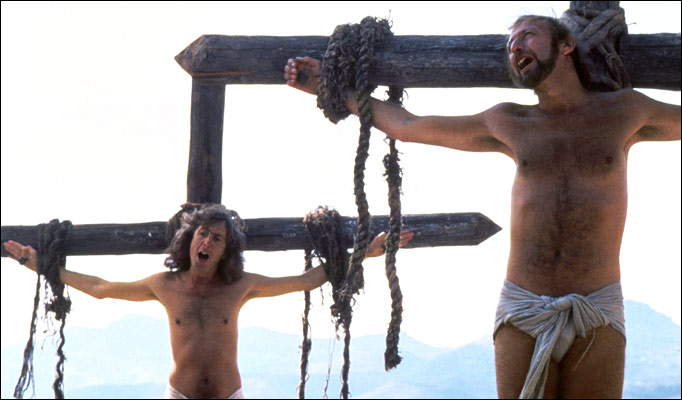
Now, I know how fucking miserable it is to be told to just "cheer up," as if it were a single, little switch to throw, so I'll simply leave this picture here, for no particular reason...

So, to sum up (gosh, that's a lot of semi-complete thoughts to try and process), life's a piece of shit, when you look at it, but you don't need imaginary gods to make it worthwhile. You don't even need real gods. You don't strictly even need real people to enjoy your life, though the way we're evolved, as social creatures, it does usually help. Your happiness, your self-worth, the value of your life and living, these are all things inside your own head. If they're not working for you, then you need to address it. I don't deny that therapy, drugs and good friendships are also important if you're properly depressed, because brain chemistry is not something to be underestimated. But for most people, the value we give ourselves is really all we can be sure of, and if you can't give yourself a respectable dose of self-respect, without first having to prostrate yourself before others, whether real or imagined, then you should be worried about yourself. Value your own life. Value the lives of your fellow sentients. And try to have fun. It's all we've got.
I've had some problems with depression before and asked myself exactly that, but it's been a while for me. And now it's come back to me, not through my own concerns, but through the concerns of two others. I think it's worth looking at for both of their sakes.
The first person's concern is that there must be a god (specifically, the christian god) or there's no point to life. This is as full of wild assumptions as it is worrying, but the main thing I'd like to focus on here is that this person blatantly thinks our lives are not inherently valuable, that we are only any good in terms of our utility value to some hypothetical invisible magic man. If we can't do shit for him (who, I remind you, is supposed to be omnipotent), then we serve no function and our lives are worth nothing. If this person could be convinced that there is no god, the implication follows, then there'd be nothing at all to stop us from killing each other, killing ourselves and generally descending into chaos, despair and ultimately total doom. This is false for two reasons.
First, and most simply, that's clearly not what we want. Humans are social creatures and by and large we're happy to live and let live, and even to help each other, build each other up and cooperatively build massive cities and states together, regardless of faith. The suggestion that we'd all descend into chaos without christianity is automatically refuted by any functioning non-christian society, of which there are plenty. (And the same applies no matter what religion you substitute in for christianity, so clearly religion is not a crucial factor.)
Second, more abstractly, shifting our inherent value into some god's inherent value doesn't actually answer the question of what the value of existence is actually worth. If our lives are worth nothing, then what's this god's life actually worth? Carl Sagan said something similar about the age of the universe, as it relates to the existence of any god. If we ask what came before god and the answer is "nothing," then surely it's simpler to just say that the age of the universe is finite. And if the answer is "god has always existed," then the simpler answer is that the age of the universe is infinite. Why focus on a single entity within the universe when what you're really asking about is the universe in general? Something similar applies here. Why worry about the value of a single entity's life (this god thing, for example) when you're really asking if life in general has value?
So not only is this religious person's assumption pretty far from being right, but the whole approach to reaching that conclusion isn't even a very good one.
The other person's worry is simultaneously more and less concerning. It's more concerning in that it stems from clinical depression, which is not nice. But while it's more directly risky, it's at least more rational. This person's sentiment can be summed up as, "If there is no absolute value to living, and I don't feel like it, then why bother?" Which is a fair question, far more deserving of a serious answer than the god nonsense. It doesn't presuppose any magical, made-up, extra shit. That doesn't necessarily mean it's correct, but at least it's a sane start.
I would argue that it's definitely a valid argument, up to a point. If we value freedom, then control over our own bodies and minds must certainly be one of the most basic freedoms we recognise. And deciding how and when and why to end your own existence is one possible expression of that freedom.
At the same time, though, we should also value the living, not in the blinkered "pro-life" sense, which puts the not-yet-living ahead of the actual living, but in the sense of appreciating and caring for each other. On the one hand, this means we should be concerned for those who want to end their lives. Some may have thought it through clearly and sanely (those with unavoidably painful and terminal diseases, for example, have a reasonably fair claim to euthanasia), but we know full well that a great many will also have come to that conclusion because they're not wholly sane. Even something as mundane as depression, which I wouldn't describe (in my amateur opinion) as an insanity, definitely skews your judgement and ought to be treatable. So until we can be certain that death really is the kindest option, we owe it to each other to obstruct suicides.
On the other hand, this valuing of the living means that those contemplating suicide need to seriously consider the effect they'll have on those they leave behind. It's hard to think of a good way to say good bye forever, but there are also clearly bad ways of doing it: Unexpectedly, sneakily, messily, dangerously, etc.
But there's more to life than merely placating others, and more to it than merely remaining medically alive. There must be something to keep us going, something to drive us and get us out of bed in the morning; something to overcome our negative emotions and general apathy, and onward on to whatever it is that marks the difference between life and living for us. Imaginary gods fill that void for some, which you may be surprised to hear I find... problematic. For most, though, I think it's largely sexual and parental instinct that push them unconsciously along. An awful lot of behaviour can be explained, not completely but at least partly, as forms of mate-seeking or fending for offspring. I know this applies to me; I operate under the illusion that obscure, semi-private bloggers get shown a lot of unexpected but pleasing nudity (and I haven't been entirely wrong), and in the past I've always shown massive increases in proper productivity (not "for my own amusement" gaming productivity) when I have a specific lady-girl to impress. I've also converted my breeding instinct into an idea-spreading instinct, because I value my memes more than my genes, and I express this through my teaching/tutoring and my writing, plus my small contribution to the skeptics' movement.
But what about those for whom none of those standard motivations seem to apply?
I'm sure there are other possibilities, but I only have my own experience to draw on here, and what springs to my mind is something some dead, old, white guy once said, or alternatively two things that my mom used to tell me. The former said something poetic about humans needing a combination of both love and work to get by. That's kind of what I'm getting at, but it's a bit vague. The latter gave me two apparently contradictory instructions as the "most important rule" I should try to live by, and it took me a long time (and perhaps some dead, old, white guys) to figure out how they fit together. The first instruction was, "First the work and then the play," a parental thing about cleaning my room before playing in it and messing it up again (incidentally, I've now streamlined that process by simply never cleaning my room and thus having everything ready at hand to play with). The second instruction, given to me on my very frightening first day of school, was, "The most important rule is to have fun."
The only logical way I've found to follow both of those instructions, those Laws of Shambotics, is to have fun while working. That's true enough in the limited sense of earning a living; I've done boring and unpleasant jobs and couldn't stick with them. But I prefer to take it beyond that, defining "work" as anything that takes more effort than vegetating in bed, whether it's going out for a night on the town or moving house or driving grandparents to doctors' appointments. Anything that's "work" must come before you can play. Even going out to see friends for something hopefully fun still takes the effort of getting off my arse and dressed and into the car. And while a lot of that might seem trivial to many people, depression makes the smallest effort seem insurmountable. (And failure to achieve what you intellectually understand to be trivial only makes you feel worse, compounding the problem. And don't even get me started on how shit it feels when people who don't know what it's like - probably don't even know you have a problem - give you additional shit for this failure.)
But! The most important rule is to have fun! My great epiphany was in realising that the instructions work in parallel, feeding off each other. Not only is that initial work necessary to get to the fun playing stuff, but the work must also be fun, or at least must be made fun. Years of roleplaying helped, and now I sort of LARP my way through the day. Looking for an unknown address isn't tricky driving and time wasted, it's a voyage of discovery. Putting myself out in the dark pit of dating despair isn't making myself socially and emotionally vulnerable, it's an opposed charisma check (that both sides are hoping to fail, oddly). Sending out CVs isn't a depressing chore, likely to end in many outright rejections before there's even a single interview, it's LFG, it's the endless, aimless nights in random taverns that must occur before the group of PCs happens to meet up together by chance for something more exciting.
It don't mean all of this completely literally. I don't stop before every task to figure out an acceptable geek analogy; it's just an attitude thing, a willfull attempt to put a more comfortable spin on the uncomfortable. With practice, it becomes an unconscious habit. And of course it doesn't always help, but it's something. It's a way of framing the world in a way that makes it more appealing and thus worth living in.
And that, I think, is largely all the big secret is: Perception. Change your way of looking at life and you can make it either worth living or not. This is not an easy thing to just change overnight, especially if the chemicals in your brain aren't helping, but it certainly can't change if you yourself are the one unwilling to let it.
Now, I know how fucking miserable it is to be told to just "cheer up," as if it were a single, little switch to throw, so I'll simply leave this picture here, for no particular reason...
So, to sum up (gosh, that's a lot of semi-complete thoughts to try and process), life's a piece of shit, when you look at it, but you don't need imaginary gods to make it worthwhile. You don't even need real gods. You don't strictly even need real people to enjoy your life, though the way we're evolved, as social creatures, it does usually help. Your happiness, your self-worth, the value of your life and living, these are all things inside your own head. If they're not working for you, then you need to address it. I don't deny that therapy, drugs and good friendships are also important if you're properly depressed, because brain chemistry is not something to be underestimated. But for most people, the value we give ourselves is really all we can be sure of, and if you can't give yourself a respectable dose of self-respect, without first having to prostrate yourself before others, whether real or imagined, then you should be worried about yourself. Value your own life. Value the lives of your fellow sentients. And try to have fun. It's all we've got.
Monday, 5 September 2011
Bigotry is Gay
We like to talk about the issues here. Issues, like hairs, are important even when they're just lying there. And we put a lot of futile effort into removing both from existence. And I've dated stylists of both. (Have I?)
My close, personal friend (in the Hollywood sense) Diaan raised an important issue the other day, and it got me thinking. Bullying is bad. I was bullied a lot in school, especially around grades 6 to 9. I "toughened up" against both the verbal and physical bullying, to the point that I could probably have taken a punch better as a 13 year-old than I could now, but it came at the cost of making me even more anti-social than I already was. I was incredibly lucky to make some great friends in high school, but anyone beyond them was problematic. (Try compounding the awkwardness of reflexively flinching when pretty girls reach out to touch you, with the embarrassment of them laughing in your face as a result.)
Luckily, in my case, I'm fine again, 10 years later, or at least can't see the scars so clearly anymore. But Diaan makes an excellent point: Bullying is unacceptable behaviour and blaming the victim is worse. And when it does go from bad to worse, it can go really fucking bad. So consider a phenomenon I've noticed increasingly at work: Blatant homophobia. Kids (all male, from what I've seen) use "gay" as an insult and dig into anyone identified as homosexual fairly viciously. The former is not unknown to me, we used to use the word that way when I was in school too, mostly because we didn't know better. After enough experience with sex, relationships and other people, most of my peers stopped saying things like that. I do still know one or two people my age who use gay as a synonym for uncool, but these are not people I'd describe as ethically deep to begin with.
But the more elaborate stuff? Is it just an attempt at wit, without any real feeling behind it? Or is it something more serious? That's harder to judge from just the snippets I hear. Obviously I feel I should say something about this to them, but it's hard to decide what's appropriate if I can't really judge the extent of the problem accurately. If they're just lightly fucking about, not really intending to cause harm, then giving them a lot of crap could chase them in the wrong direction as they try to rationalise why my shouting at them was the real crime. In that case, a casual, dispassionate bit of advice seems wiser; treat them as adults, and even if they don't act like adults yet, so they've at least got a better idea of what's expected of adults. And if they are intentionally being cruel and homophobic, then a quiet "don't do that" is unlikely to be sufficient.
This, I think, is a problem that belies all attempts at dealing with bullies. You have to first understand the nature of the bullying, and then determine how best to deal with it based on that. And that's damn tricky sometimes. Perhaps that's part of the reason bullying has become accepted in so many schools (and beyond); it's easier to rationalise it as "character building" than to do the hard work of investigating and understanding the problem properly. And so things spiral out from there, I guess.
What particularly worries me is when I can see the younger kids learning their homophobia from the older ones. That's clearly a point to leap in and intervene, but how exactly? I don't want to give the younger kids any basis to imagine the older ones are somehow being cool and rebellious, but I still need to get through to the older ones. It's a horrible juggling act. Any clever advice?
My close, personal friend (in the Hollywood sense) Diaan raised an important issue the other day, and it got me thinking. Bullying is bad. I was bullied a lot in school, especially around grades 6 to 9. I "toughened up" against both the verbal and physical bullying, to the point that I could probably have taken a punch better as a 13 year-old than I could now, but it came at the cost of making me even more anti-social than I already was. I was incredibly lucky to make some great friends in high school, but anyone beyond them was problematic. (Try compounding the awkwardness of reflexively flinching when pretty girls reach out to touch you, with the embarrassment of them laughing in your face as a result.)
Luckily, in my case, I'm fine again, 10 years later, or at least can't see the scars so clearly anymore. But Diaan makes an excellent point: Bullying is unacceptable behaviour and blaming the victim is worse. And when it does go from bad to worse, it can go really fucking bad. So consider a phenomenon I've noticed increasingly at work: Blatant homophobia. Kids (all male, from what I've seen) use "gay" as an insult and dig into anyone identified as homosexual fairly viciously. The former is not unknown to me, we used to use the word that way when I was in school too, mostly because we didn't know better. After enough experience with sex, relationships and other people, most of my peers stopped saying things like that. I do still know one or two people my age who use gay as a synonym for uncool, but these are not people I'd describe as ethically deep to begin with.
But the more elaborate stuff? Is it just an attempt at wit, without any real feeling behind it? Or is it something more serious? That's harder to judge from just the snippets I hear. Obviously I feel I should say something about this to them, but it's hard to decide what's appropriate if I can't really judge the extent of the problem accurately. If they're just lightly fucking about, not really intending to cause harm, then giving them a lot of crap could chase them in the wrong direction as they try to rationalise why my shouting at them was the real crime. In that case, a casual, dispassionate bit of advice seems wiser; treat them as adults, and even if they don't act like adults yet, so they've at least got a better idea of what's expected of adults. And if they are intentionally being cruel and homophobic, then a quiet "don't do that" is unlikely to be sufficient.
This, I think, is a problem that belies all attempts at dealing with bullies. You have to first understand the nature of the bullying, and then determine how best to deal with it based on that. And that's damn tricky sometimes. Perhaps that's part of the reason bullying has become accepted in so many schools (and beyond); it's easier to rationalise it as "character building" than to do the hard work of investigating and understanding the problem properly. And so things spiral out from there, I guess.
What particularly worries me is when I can see the younger kids learning their homophobia from the older ones. That's clearly a point to leap in and intervene, but how exactly? I don't want to give the younger kids any basis to imagine the older ones are somehow being cool and rebellious, but I still need to get through to the older ones. It's a horrible juggling act. Any clever advice?
Subscribe to:
Posts (Atom)